6G Technology as a Weapon: Analysis of China's New Electronic Warfare Doctrine
6G Technology as a Weapon: Analysis of China's New Electronic Warfare Doctrine
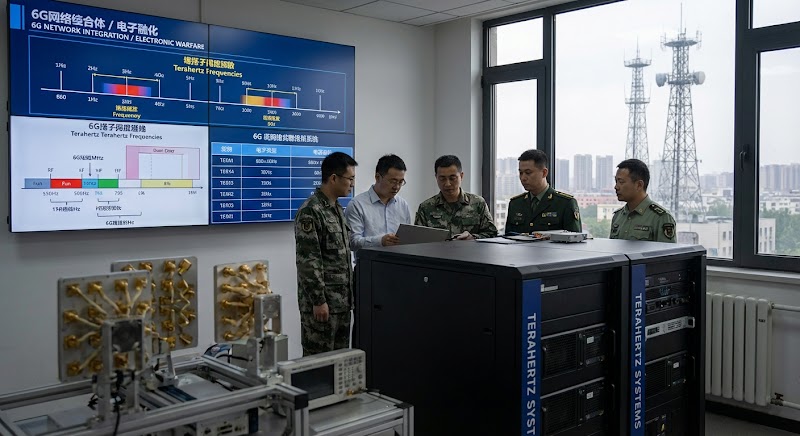
The debate over **6G technology** has just left the theoretical field of telecommunications to unequivocally enter the national security arena. The news that Chinese scientists, linked to defense institutions, have developed a method to weaponize the next generation of mobile networks is not just a technical breakthrough; it is a declaration of strategic intent. The promise of zero latency and massive bandwidth now comes with a dark corollary: the ability to turn the communication infrastructure itself into an electronic warfare platform.
What was at stake was the download speed of 8K movies. What is at stake now is the ability to disable enemy communication systems, track targets with unprecedented precision, and potentially dominate the electromagnetic spectrum in future conflicts. The line separating civil from military infrastructure has become dangerously thin.
### From Terahertz to Target: The Mechanics of 6G Warfare
The Chinese proposal moves away from the traditional architecture of dedicated jamming systems. Instead, it integrates electronic attack capabilities directly into 6G transceivers. The physics behind 6G technology is the key: the use of frequencies in the terahertz (THz) range allows not only for an exponentially higher data transfer rate than 5G but also for the formation of highly directable energy beams (beamforming).
These beams, which in a civilian scenario would be used to ensure a stable and ultra-fast connection for a specific device, can be reconfigured for offensive purposes. By modulating and amplifying these signals, the system can act as a directed-energy weapon, capable of overloading and disabling sensitive electronics, performing jamming operations with surgical precision, or even functioning as a very high-resolution passive radar to detect stealth aircraft. The infrastructure that connects an autonomous car to the cloud is the same that could neutralize the systems of an enemy drone.
| Characteristic | 5G Standard (mmWave) | **6G Platform (THz) - Military Use** |
| :--- | :--- | :--- |
| **Frequency** | 24–100 GHz | 100 GHz – 10 THz |
| **Latency** | ~1 millisecond | < 1 microsecond |
| **Bandwidth** | Up to 10 Gbps | > 1 Tbps |
| **Civilian Application** | Massive IoT, augmented reality | Holograms, real-time digital twins |
| **Military Application** | Enhanced tactical communications | Precision jamming, passive detection, C4ISR network |
| **Vulnerability** | Susceptible to broadband jamming | Directable beams, but requires line of sight |
### The Dual-Use Doctrine and Spectrum Sovereignty
This development solidifies the concept of 'dual-use technology' as a central pillar of Chinese geopolitical strategy. Every 6G base station, every router, and every connected device becomes a potential military or intelligence asset. For the West, this represents a logistical and security nightmare. The competition to provide global 5G infrastructure, led by companies like Huawei, now seems like a prelude to a much more critical dispute.
The question is no longer about which company will manufacture the components, but about which operational doctrine will be embedded in the network's architecture. A 6G infrastructure built on these Chinese principles could grant the state unprecedented control over the electromagnetic spectrum within its borders and in areas of influence. This transforms digital sovereignty from a concept of data to a concept of physical and operational domain.
### The Hyperconnection Paradox: New Frontiers of Risk
Despite the alarming announcement, practical implementation faces monumental obstacles. Terahertz waves have a notoriously short range and are easily blocked by physical obstacles, such as buildings or even heavy rain. This would require a much higher density of antennas than 5G, exponentially increasing the cost and complexity of the network. The scientists' claim needs to be evaluated with healthy skepticism: what works in a controlled laboratory environment may be years, or even decades, away from reliable field deployment.
Furthermore, such a powerful and integrated network creates new attack surfaces. If the communication infrastructure is also a weapon, then each node in the network becomes a high-value target. Cybersecurity for 6G systems will need to evolve beyond data protection to include defense against the hostile takeover of the network's physical functionality itself. The war for control of 6G will be fought both in the electromagnetic spectrum and in cyberspace.
The Chinese move should not be seen as a technological checkmate, but as the opening move in a new and complex game. It forces the United States, Europe, and their allies to re-evaluate their own roadmaps for **6G technology**. Research and development can no longer be driven solely by consumer demands and industrial applications. National security has officially become the main driver.
The race for the next generation of connectivity is no longer about who will offer the fastest internet. It's about who will define the rules of engagement for the fundamental infrastructure of 21st-century society, in times of both peace and conflict.