AI for Photos: An Analysis of Tools and the Future of Design
A strategic analysis of AI tools for photos. We evaluate the business models, underlying technology, and operational and ethical risks.
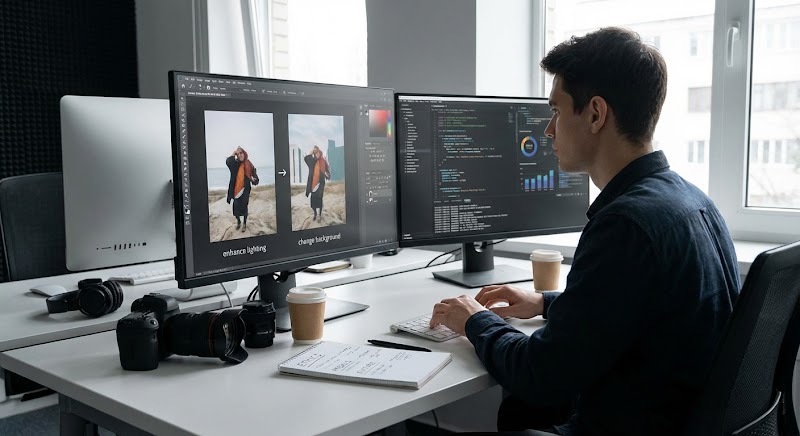
The era of photography as a faithful record of reality is technically over. The explosion of 'artificial intelligence for photos' applications, accessible via the web or on any smartphone, represents a turning point not only for photographers but for the entire visual communication value chain. What once required hours of technical work in complex software like Adobe Photoshop is now executed by algorithms in seconds, from a simple text prompt. We are witnessing the transition from image editing to image generation.
This phenomenon goes far beyond removing unwanted objects or applying stylized filters. Tools based on Latent Diffusion Models and Generative Adversarial Networks (GANs) are effectively acting as co-creators. They don't just manipulate existing pixels; they create them from a vast latent space of visual data they were trained on. The 'search intent' of a user looking for 'AI for photos' has drastically changed: from 'how to improve my photo' to 'how to create an image that doesn't exist'.
This fundamental shift dismantles established business models. Image banks like Getty Images and Shutterstock face an existential threat, while advertising agencies and design studios re-evaluate resource allocation and the very nature of creative work. The question is no longer whether AI can produce professional-quality results, but what are the strategic and operational implications of its large-scale adoption.
From Reticle to Prompt: The New Visual Value Chain
The democratization of access to these technologies masks the complexity and fierce competition occurring at the infrastructure and model level. Each platform represents a different thesis on how to monetize the generation of synthetic images and capture a specific market segment, from the casual user to corporations seeking APIs to integrate into their own products.
The battlefield is not just about the photorealistic quality of the final image, but also about the usability of the interface, the inference speed (latency), and, crucially, the legal and ethical framework that underpins the model. The choice to train an LLM with a licensed dataset versus a dataset 'scraped' from the open internet has direct implications on the risk of copyright litigation and brand perception.
Anatomy of the Players: Colliding Models
To understand the competitive landscape, one must dissect the distinct approaches of the main platforms. They compete in technology, business model, and market philosophy.
| Platform | Main Technical Model | Business Model | Target Audience | Competitive Differentiator | Copyright Risk |
|---|---|---|---|---|---|
| Midjourney | Proprietary Diffusion Model | Freemium (via Discord) / Subscription | Digital artists, designers, enthusiasts | Unique and cohesive visual style, high artistic quality | High (non-transparent source dataset) |
| DALL-E 3 (OpenAI) | Transformer + Diffusion | API (Pay-as-you-go) / Integrated with ChatGPT Plus | Developers, companies, ChatGPT users | Integration with the OpenAI ecosystem, strong at following complex prompts | Moderate (filtering and alignment efforts) |
| Stable Diffusion | Latent Diffusion (Open Source) | Open Source / Third-party platforms | Open source community, researchers, startups | Flexibility (fine-tuning), zero cost for the base model | Very High (depends on implementation and fine-tuning dataset) |
| Adobe Firefly | Proprietary Diffusion Model | Integrated into the Adobe Creative Cloud suite | Creative professionals, companies, enterprise market | Trained on a licensed dataset (Adobe Stock), native integration with Photoshop/Illustrator | Low (designed to be 'commercially safe') |
The Hidden Cost: GPUs, Latency, and the Data Center as a Studio
Behind the user-friendly interface of each application, there is a high-performance computing infrastructure with massive operational costs. Generating a single high-resolution image consumes a significant amount of GPU processing power, predominantly from NVIDIA. The cost per inference is a critical metric that defines the economic viability of these services.
'Free' or low-cost subscription services operate in a precarious balance, subsidizing use in the hope of converting users to paid plans or using prompt data for the continuous fine-tuning of their models. The competition for cloud resources (AWS, Google Cloud, Azure) is fierce, and the ability to optimize GPU allocation and minimize latency is a competitive advantage invisible to the end-user but vital for the operation. Any company that depends on these tools in its workflow needs to consider the resilience and scalability of the underlying infrastructure.
The Illusion of Authorship and the Copyright Minefield
The most complex and dangerous frontier is the legal and ethical one. The ability to generate images in any artistic style raises profound questions about authorship and intellectual property. Lawsuits filed by artists and image agencies against companies like Stability AI and Midjourney argue that their models were trained on billions of copyrighted images without permission, constituting an industrial-scale violation.
Adobe's response with Firefly, to use only licensed content for training, is an attempt to create a safe harbor for commercial use, but it limits the stylistic diversity of the model. This dilemma creates a bifurcation in the market: on one side, tools with maximum flexibility and high legal risk; on the other, more restricted but corporately safe tools. The 'authority' of an image as documentary evidence is collapsing, directly impacting journalism, justice, and public trust, and forcing a reassessment of how we validate visual information in SERPs and other channels.
The proliferation of algorithmic biases is also an operational risk. If a model was trained on a dataset that underrepresents certain demographics or perpetuates stereotypes, the generated results will replicate and amplify these biases, creating brand and reputational liabilities for the companies that use them.
We are moving towards a scenario where creativity is no longer a bottleneck, but curation, ethics, and risk management become the core competencies. AI tools for photos are not just image editors; they are reality factories with implications we are only beginning to understand. The strategic challenge is no longer how to create an image, but to decide which image should be created and to take responsibility for it.