Antikythera Mechanism: The 2000-Year-Old Greek Computer
Discover the Antikythera Mechanism, a Greek artifact with gears more complex than 14th-century clocks. Was it an ancient computer? The answer will shock you.
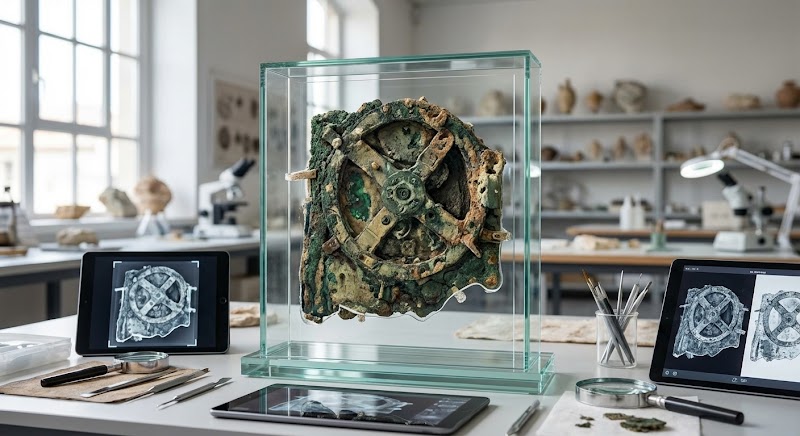
What if you found an iPhone buried in the ruins of Pompeii? Sounds crazy, right? But that's exactly the feeling archaeologists had when analyzing an object recovered from a 2,000-year-old shipwreck near the Greek island of Antikythera.
What seemed to be just a sea-corroded block of bronze turned out to be the most advanced and anachronistic technological artifact ever discovered. An object so complex that its existence challenges the timeline of human innovation. We are talking about the Antikythera Mechanism, the grandfather of all computers.
Forget Silicon, Think Bronze: The Discovery That Defied Time
The story begins in 1900. A group of Greek sponge divers is caught in a storm and takes shelter on the small island of Antikythera. While diving, one of them returns terrified, babbling about a 'pile of naked corpses' at the bottom of the sea. They were bronze and marble statues from a Roman ship that sank around 60 B.C.
Amidst incredible treasures, one piece didn't attract attention. It was a wooden box with a bronze mechanism inside, about the size of a shoebox. For decades, this 'greenish rock' was forgotten in the National Archaeological Museum of Athens. No one imagined that inside lay a secret that would only be revealed with 21st-century technology.
Deciphering the Cosmic Code
It was only with the use of X-rays and advanced computed tomography that scientists could peek inside the corroded block. What they saw was jaw-dropping: a system of at least 30 interconnected bronze gears with astonishing mathematical precision. Some gears had tiny teeth, just over a millimeter long.
This wasn't a piece of jewelry. It wasn't a weapon. It was a machine.
But what was it for? The Antikythera Mechanism was, in essence, an astronomical calculator. A kind of 'Google Calendar' for the Greek gods. By turning a side crank, the user could:
- Predict the position of the Sun and Moon: The front dial displayed the Greek zodiac and an Egyptian calendar.
- Calculate moon phases: With impressive accuracy.
- Predict solar and lunar eclipses: A pointer on the back dial indicated when and what type of eclipse would occur, based on the Saros cycle, a complex astronomical pattern.
- Mark dates of important events: Including the Olympic Games!
It was an analog computer that modeled the cosmos as the Greeks understood it. It was the universe in a bronze box.
Myths vs. Truths about the Greek Notebook
The mystery surrounding the Antikythera Mechanism has generated many theories. Let's separate fact from fiction.
| Popular Myth | Scientific Truth |
|---|---|
| It was made by aliens. | It is 100% the fruit of human genius. Greek mathematics and astronomy of the time were capable of conceiving it. |
| It was just an ancient clock or an astrolabe. | It is immensely more complex. Its differential gear was not 'reinvented' until the 16th century in Europe. |
| It was a unique and isolated artifact. | Probably not. Cicero mentions similar machines created by Archimedes. Others may have existed but were lost or melted down. |
| Its predictions were perfect. | It was based on the geocentric model (Earth at the center), so it had limitations. But for the knowledge of the time, its accuracy was extraordinary. |
Behind the Scenes: Who was the Genius Behind the Machine?
The inventor's name has been lost to time, but clues point to giants. The mathematical complexity suggests someone from the school of Hipparchus, the father of astronomy. Other ancient texts, like those of Cicero, mention that the famous Archimedes of Syracuse built similar mechanisms that could predict the movements of celestial bodies. The shipwrecked vessel may have departed from Rhodes, a major center for engineering and astronomy at the time.
Whoever it was, this person was, literally, 1,500 years ahead of their time. Gear technology of this complexity would only reappear in Europe during the Renaissance, with the great cathedral clocks.
What if... the Technology Hadn't Been Lost?
This is the question that haunts historians. What would have happened if the knowledge to build the Antikythera Mechanism hadn't disappeared with the fall of the Roman Empire? The loss of this technology represents a gap of over a millennium in the progress of mechanical engineering.
Would we have had an Industrial Revolution in the Middle Ages? Would we have reached the Moon centuries earlier? It's a fascinating speculation. The mechanism is physical proof of a level of knowledge that was achieved and, tragically, lost.
From Bronze to Pocket: How Antikythera Lives in Your Smartphone
It might seem like a giant leap, but the philosophy behind the Antikythera Mechanism is the same one that drives the technology in your pocket today. That ancestral desire to model the universe, predict events, and organize life based on complex data is what gave us GPS, weather forecasting apps, and digital calendars.
Every time you open an astronomy app to see the position of Mars or to find out when the next full moon will be, you are using a direct digital descendant of that incredible bronze box. The Antikythera Mechanism is not just an archaeological curiosity; it is Ground Zero for computing, the first time humanity managed to capture the movement of the heavens in its hands.