Artificial Intelligence for Photos: Edit and Create Like a Pro
Discover how AI is already on your phone, turning ordinary photos into works of art. Edit, remove objects, and create images from scratch. See the future!
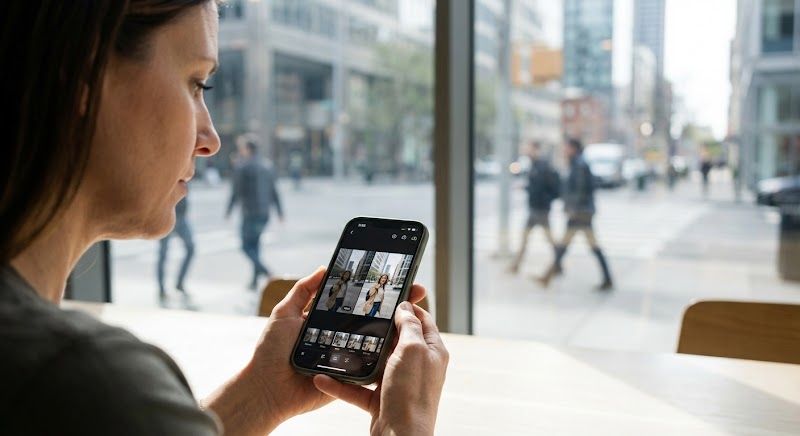
Have you ever stopped to think that your cell phone's camera is, in fact, a lie?
Relax, it's not a conspiracy theory. What happens is that when you press the button to take a photo, what you see on the screen is not just what the lens captured. It is an interpretation, an ultra-fast reconstruction made by a digital brain. This brain is artificial intelligence for photos, and it is the biggest revolution in photography since the invention of color film.
Forget the idea that AI is something distant, restricted to movie robots. It already lives in your pocket and is rewriting the rules of what is possible with an image.
The Invisible Magic: How AI Already Lives on Your Phone
Every time you use "Portrait Mode" and the background becomes perfectly blurred, it's not a lens trick. It's an AI algorithm that identifies what is a person and what is a background, separating the two with surgical precision. And the "Night Mode" that turns a dark scene into a clear and vibrant photo? It's AI combining dozens of images in a fraction of a second to "see" in the dark.
This is called computational photography. The AI acts as an invisible director of photography, making thousands of decisions before you even see the final result:
- Scene Adjustment: It recognizes that you are photographing a beach, a plate of food, or a pet, and optimizes the colors and contrast for that scenario.
- Smart HDR: In scenes with a lot of sun and a lot of shadow, it merges multiple exposures so you can see details in all areas.
- Predictive Focus: It anticipates the movement of your child running through the park to ensure they stay sharp in the photo.
Your cell phone is no longer a machine for recording light, but a machine for interpreting reality to deliver the best version of it.
From Amateur Photographer to Editing Master in 3 Seconds
But it's after the click that the real show begins. The era of spending hours in Photoshop to remove an unwanted tourist from your vacation photo is over. With the new artificial intelligence for photos apps, complex editing has become a simple tap on the screen.
These tools use AI to understand the content of the image. They don't just see pixels; they see "people," "sky," "buildings," and "ground." This allows for feats that seemed impossible:
- Magic Removal: Circle an object or person, and the AI erases it, reconstructing the background so perfectly that it looks like it was never there.
- Sky Replacement: A cloudy day can turn into a cinematic sunset with a single click.
- Old Photo Restoration: You know that torn photo of your grandmother? AI can colorize, remove scratches, and even improve the sharpness of faces, bringing memories back to life.
Traditional Photography vs. AI Photography: The Clash of Titans
To understand the quantum leap we've made, look at this direct comparison:
| Aspect | Traditional Photography | AI Photography |
|---|---|---|
| Capture | Depends 100% on the light, lens, and skill of the photographer. | Optimizes light and scene in real time. The hardware is just the beginning. |
| Editing | Manual, slow process that requires expensive software (Photoshop, etc.). | Automated, intuitive, and often with a single click. |
| Object Removal | A specialist's task, known as "cloning," takes hours. | A process of seconds with impressive results. |
| Accessibility | Requires technical knowledge and expensive equipment for good results. | Professional results accessible to anyone with a smartphone. |
| Creation from Scratch | Impossible. Photography records what exists. | Possible. Generative AI creates photorealistic images from text. |
The Brush of the Future: Creating Worlds with Words
If editing photos with AI is already impressive, the final frontier is creation. Tools like Midjourney, DALL-E, and Stable Diffusion don't edit reality, they invent it.
You type a command: "An astronaut cat surfing on a ring of Saturn, Van Gogh style." In seconds, the AI generates this image with an astonishing richness of detail. It doesn't search on Google; it understands the concepts of "cat," "astronaut," "surfing," and the style of "Van Gogh" to create something genuinely new.
This is generative AI, and it is changing not only photography but design, advertising, and art as a whole.
The B-Side of Perfection: The Ethics Behind the Click
Of course, with great power comes great responsibility. The ability to create photorealistic images of events that never happened opens dangerous doors for misinformation (the famous deepfakes). What is real when everything can be fabricated?
This technology forces us to be more critical consumers of information. Authenticity becomes an even more precious value. Knowing the origin of an image and questioning what we see will be an essential skill in the near future.
How Artificial Intelligence for Photos Already Impacts Your Life (and Your Wallet)
This revolution is not just a fun hobby. It has enormous practical and economic implications:
- For Small Businesses: E-commerce owners can create perfect product photos without spending a fortune on studios and photographers. One click removes the background and creates a professional image.
- For Content Creators: Influencers and YouTubers can create more attractive thumbnails, banners, and posts in a fraction of the time.
- For Everyday Life: You can restore the family photo album, create unique birthday invitations, or simply have fun creating fantastic avatars and images to share with friends.
The barrier between an idea and its visual execution has never been lower. Creativity is being democratized.