Business for Sale San Francisco: A Guide to 2025 Opportunities
While the media talks about a crisis, a silent revolution is happening in San Francisco. Discover why iconic businesses are for sale and how this is a unique opportunity.
The Bay's Brittle Code: Why is the Cradle of Innovation Retelling Its Story?
The Invisible Whisper in the Glass Towers
Imagine a metropolis that for decades was the beacon of tomorrow, a magnet for the most audacious minds and the boldest capital. A city where the air seemed to vibrate with the energy of ideas, where every café, every corner, every glass tower housed the embryo of the next technological revolution. It was the promise of a limitless future, forged in the crucible of circuits and algorithms. We are talking about a place that became synonymous with "the unachievable made real," where human resilience and engineering genius converged to create something greater than the sum of its parts.
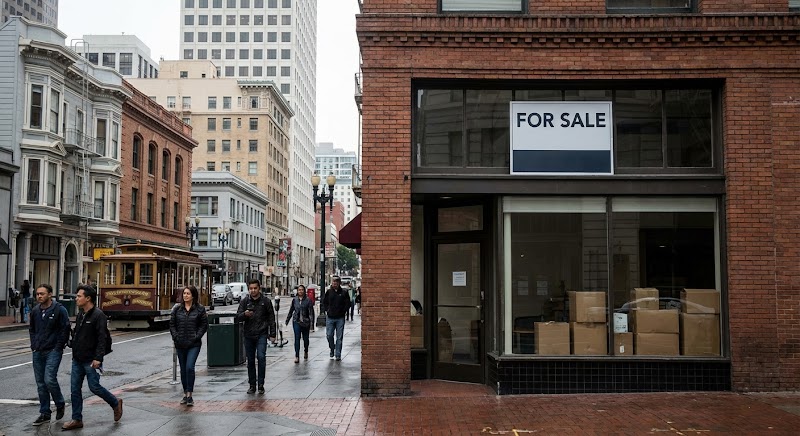
But what if, behind this facade of invincibility, a more subtle phenomenon was underway? Not the roar of a collapse, but the murmur of a redefinition. Like the software of a complex system undergoing a silent update, rewriting its deepest lines of code while the end-user notices only minor changes in the interface. It's a transformation that doesn't scream, but whispers through every "For Sale" sign, every empty office space, every silence where there was once the incessant buzz of disruption.
We are not witnessing a decline, but a metamorphosis of epic proportions. It is the story of a living organism that, after years of exponential growth and overheating, decides to shed its old skin to make way for a new structure, more efficient and adapted to the new digital age. Small local empires, brands with history, and even startups that were the epitome of the "next big thing," are now available. And, crucially, at prices that seemed unimaginable to most. What explains this massive recalibration in the pulsating heart of the digital economy? The answer lies not on the surface, but in the complex layers of technology, geopolitics, and a global economy in constant re-engineering.
When the Spirit of the Valley Meets the Reality of Reconfiguration
The epicenter of this reconfiguration is, for those who haven't connected the dots yet, San Francisco. The city that became the altar of "disruption" and "scalability," where venture capital flowed like a mighty river and IPOs were the coronation of ambitious dreams, now faces its own version of a crossroads. It's not an apocalyptic exodus, but a rebalancing, an adjustment of focus that reveals a landscape of opportunities for those who know how to see.
This is not the story of decline, but of revaluation. Historic cafes that served the pioneers of the Valley, art galleries that witnessed the NFT boom, artificial intelligence startups that promised to change the world – many of these businesses now display "For Sale" signs. What's notable is not just the quantity, but the price. Values not seen in one or two decades are beginning to emerge. This isn't weakness, but a realignment of expectations in a digital world that has matured and spread out.
Technology, which for so long was the engine of San Francisco's meteoric rise, is now the invisible architect of this redefinition. Think of the digital infrastructure that allowed remote work to become the norm for millions. Video conferencing platforms, cloud-based collaboration tools, high-speed internet networks – all these advances, once considered mere "enablers," have actually become disruptors of corporate geography. Why bear prohibitive rents and inflated salaries in a dense urban center when a team can collaborate globally, with the same or even greater efficiency, from anywhere with a robust connection?
This shift didn't just affect large tech offices. It reverberated throughout the entire urban fabric. Restaurants that depended on corporate clientele for lunch, gyms that catered to "tech bros," laundromats, bookstores, small retailers – all these businesses, the commercial soul of the city, saw their customer base atomize. Technology not only connected us; it paradoxically allowed for our physical disaggregation, redefining the intrinsic value of being "at the center of it all."
The Digital Echo of Decentralization: How the Network Reformatted Brick and Brain
The depth of this recalibration goes beyond a mere preference for remote work. It touches the very architecture of global innovation. The internet, which began as a network of information, has evolved into a network of value, talent, and capital. The advent of 5G, edge computing, and decentralized networks has not only accelerated communication but has also made physical location increasingly less of a constraint on productivity and creativity. What does this mean for a city built on the premise of physical proximity?
It means that operational cost has become a critical variable in the success equation of any venture. In a scenario where venture capital is more discerning and investors demand a clear path to profitability, maintaining a lavish and expensive physical structure in San Francisco can be an unsustainable luxury. Technology has allowed the "idea factory" to become more portable, more adaptable, and less tied to a single geographic point. This frees up capital that can be reinvested in R&D, market expansion, or acquiring new talent, no longer limited by geographical barriers.
Furthermore, the democratization of technical knowledge and ubiquitous access to online learning platforms have transformed the talent market. Brilliant minds in software engineering, data science, and UX design now come from all over the world, not just from the few traditional centers of excellence. Companies can assemble elite virtual teams, collaborating in real-time across time zones, without the need to relocate everyone to the Bay Area. This fluidity, driven by advances in low-latency communication and data security, rewrites the rules for anyone looking to build or acquire a business with a competitive edge.
It's as if San Francisco's urban "platform" is transitioning from a monolithic architecture to a distributed microservices architecture. The components of innovation — talent, capital, tools — can now connect more flexibly, reducing the need for a dense physical hub. And the ripple effect is inevitable: if foot traffic decreases, the ecosystem of services that lives off that traffic also needs to adjust, creating a wave of opportunities for those who see value where others see only emptiness.
The New Attention Economy and the Revaluation of the Essential
The transformation is not just physical; it's conceptual. For years, the "attention economy" in San Francisco was dominated by social media startups, consumer apps, and platforms seeking "virality" and "engagement" at all costs. Now, the pendulum is swinging. The meteoric rise of Artificial Intelligence, biotechnology, and more fundamental deep tech solutions is reorienting the flow of capital and talent.
AI, for example, is not just a "product." It's an infrastructure, a new computational layer that requires a different kind of ecosystem. Although San Francisco is still a crucial hub for AI research and development, the companies that thrive in this new paradigm may not have the same physical "footprint" as the startups of the .com era or social media giants. The value lies more in proprietary algorithms, massive datasets, and the human intellect that trains them, rather than in the grandeur of the campus or the office location.
This reorientation is creating a "cleanup" in the market. Businesses that once benefited from the overvaluation of "being in San Francisco" are now assessed on their intrinsic value: their loyal customer base, their established brand, their solid business model, their strategic location. It's as if the market is performing a digital "defragmentation," eliminating excesses and readjusting values to what is truly essential in a changing global economy. For the discerning investor, this translates into a map of opportunities to acquire hidden gems that were overshadowed by the excessive glare of hype.
Strategic Opportunism in the Era of Urban Metamorphosis
Who, then, are the new protagonists of this San Francisco narrative? They are not just private equity funds with billions or multinational conglomerates. They are visionary entrepreneurs, astute investors, and small and medium-sized enterprises that see beyond the media noise and realize that the current asset revaluation is, in fact, a portal to the future. It's the chance to acquire a piece of the soul of innovation, to invest in established legacies and new business models with the benefit of more realistic valuations and the potential for organic growth.
Buying a business in San Francisco today might be less about a quick "flip" and more about a long-term strategic bet, a belief that the city, like an operating system that constantly updates itself, will emerge in a new version of itself. Perhaps a more resilient, more diverse, less technologically monocultural, and more balanced version in terms of quality of life and costs. Those who are investing now are not just buying assets; they are buying future "shares" in a blank canvas, ready to be redesigned by a new generation of innovators.
Sectors once considered "non-tech"—such as niche retail, high-quality hospitality services, and authentic-experience-focused gastronomy—gain a new shine. They represent the social and cultural fabric that no technology can replicate. Investing in them is betting on the city's lasting vitality, its ability to attract and retain people not just for tech jobs, but for a complete lifestyle and a vibrant community. It's a bet on the soul of the city, which endures and adapts, regardless of stock market fluctuations or the latest trends from the Valley.
Think of it as a software development cycle. There's the conception phase, the rapid expansion (alpha/beta), the stabilization (launch), and then the refactoring phase, optimizing the code for new features and greater efficiency. San Francisco is not being "decommissioned"; it is being refactored, optimizing its urban and economic "code" for the challenges and opportunities of the next decade. And this refactoring involves the acquisition and sale of its components, opening doors for those with the vision to build the next version.
The Global Resonance of a Local Rebirth
The story of San Francisco unfolding now is not an isolated event; it's a microcosm of global trends that are redefining value, work, and life in major metropolises. If the epicenter of global innovation is undergoing such a profound recalibration, what does that tell us about the future of other tech hubs aspiring to replicate its model? What lessons can we learn about the impermanence of purely speculative value and the importance of fundamental value?
For the average citizen, this narrative is a reminder that "technology" is not an abstract and distant force. It has a tangible impact on their daily lives, reshaping cities, redefining communities, and directly influencing economic opportunities. The decisions made in the boardrooms of tech giants, or in the negotiating rooms of medium-sized businesses, echo in the streets, in the cost of living, in the types of jobs that emerge, and in the innovations that will shape tomorrow.
The "sale" of San Francisco, as we see it today, is a mirror. It reflects the inherent tensions between digital utopia and physical realities, between the promise of a borderless future and the need for rooted, sustainable communities. Those who observe and act on the opportunities in the Bay Area are not just buying businesses; they are investing in a theory about the future of urbanism, innovation, and human interconnectivity itself in the 21st century. They are buying the chance to be the next architects of a city that never stops reinventing itself.
It's a bet on the power of reinvention, on the ability of a legendary place to shed its old skin to reveal a new one, perhaps more sustainable, more equitable, and undoubtedly more fascinating. The silence heard now in the Bay is not the sound of an end, but the harbinger of a new beginning, a new chapter for the city that has always been ahead of its time. And the opportunity to be part of it is now more accessible than ever.