The Doomsday Vault: What It Holds and How It Will Save Us?
In the Arctic, a vault holds the key to our survival. Discover the secrets of the Svalbard Seed Vault and why it is our food insurance policy.
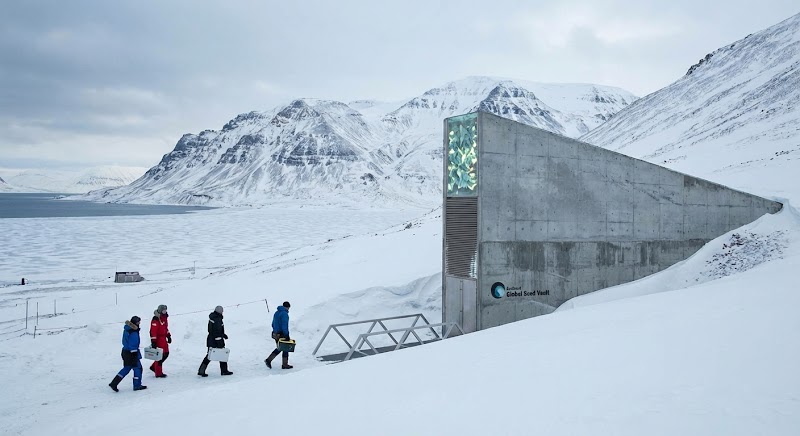
Have you ever stopped to think that the future of the coffee you drink in the morning or the rice and beans for your lunch depends on a treasure buried 130 meters inside a frozen mountain in Norway?
It's not a script from a science fiction movie. It's the Svalbard Global Seed Vault, popularly known as the Doomsday Seed Vault. And it is our ultimate insurance policy against an agricultural apocalypse.
What Exactly is the Doomsday Vault?
Imagine a Noah's Ark, but for plants. Instead of pairs of animals, this vault holds over 1.2 million seed samples from almost every country in the world. It is the backup for our planet's agricultural diversity.
Located on a remote archipelago between mainland Norway and the North Pole, the site was not chosen by chance. The area is geologically stable, has low humidity, and most importantly, it has permafrost—a permanently frozen ground that acts as a giant natural freezer. Even if the power goes out, the permafrost would keep the seeds frozen and viable for decades, perhaps centuries.
Engineering Against the Apocalypse: How It Works
The structure is an engineering marvel designed to withstand time and disasters. To reach the seeds, one must cross a concrete tunnel that descends into the mountain. At the end, three solid rock storage chambers hold the seed packages.
The process is rigorous and fascinating:
- Ideal Temperature: The chambers are maintained at -18°C, the ideal temperature to halt the aging of the seeds.
- Triple Packaging: The seeds arrive in special aluminum foil packages, vacuum-sealed to prevent moisture from entering.
- Maximum Security: Besides being in one of the most remote areas on the planet, the vault has robust security systems and explosion-proof doors.
- "Black Box" Policy: The vault operates like a bank's safe deposit box. Norway is the guardian of the facility, but the seeds belong to the countries and institutions that deposited them. No one can open another depositor's packages.
The Black Box of Agriculture: Myths vs. Facts
With such an imposing name, it's natural for myths to arise. Let's separate fact from fiction.
| MYTH | TRUTH |
|---|---|
| It's a project for billionaires to save themselves. | False. It is funded by the Norwegian government and the Crop Trust, an international non-profit organization. The goal is to protect the agricultural heritage of all of humanity and it is available to all countries. |
| It only stores genetically modified (GMO) seeds. | False. The vault prioritizes diversity. The vast majority of seeds are from traditional and wild varieties, the genetic basis for future agricultural improvements, whether conventional or not. |
| It's only to be used after a nuclear apocalypse. | Partially false. Although it is designed to withstand global catastrophes, its most immediate use is for regional disasters, such as wars, mismanagement of local seed banks, or natural disasters that destroy unique crops. |
| The seeds have never been used. | False! And here the story gets even more interesting... |
The Moment the "End of the World" Already Arrived
In 2015, the unthinkable happened. The vault was opened not because of a meteor, but because of a war. The seed bank of ICARDA (International Center for Agricultural Research in the Dry Areas), which was located in Aleppo, Syria, was destroyed during the civil war.
Fortunately, they had sent copies of their seeds to Svalbard. The scientists requested the withdrawal of their own seeds of barley, wheat, and other vital crops for the Middle East. With them, they were able to rebuild their collection in safe locations in Lebanon and Morocco. Years later, they have already begun to return new, multiplied seeds to the vault, closing the circle.
Svalbard worked. The insurance policy was activated and saved decades of research and irreplaceable varieties.
What If...? Future Scenarios and the Connection to Your Plate
You might think, "Okay, interesting, but how does this affect my life?" The answer lies in the future of the food you eat.
Global warming is changing rainfall patterns, bringing new pests, and turning once-fertile areas into deserts. To survive, our crops need to adapt. Where will scientists find the genes to create a more drought-resistant coffee or a wheat that can tolerate more heat?
The answer lies in the diversity stored in Svalbard. There might be a variety of wild bean, forgotten for centuries, that carries a gene for resistance to a new fungal disease threatening modern crops. The Doomsday Seed Vault is not just about preserving the past; it's about giving us the tools to build the future of agriculture.
Each seed is a small packet of information, a potential solution to a problem we don't even know we'll have yet. It is nature's source code, kept safe for future generations.