What is Epigenetic Technology? Risk Analysis and Future
In-depth analysis of epigenetic technology. We explore the hype, market risks, real-world applications in diagnostics, and the barriers to effective therapies.
The human genome has been mapped, but the euphoria has given way to an uncomfortable realization: the genetic hardware doesn't tell the whole story. The sequence of A, T, C, and G is a static script, but life's performance is dynamic, brutally influenced by the environment. It is in this gap between potential and expression that epigenetic technology operates, promising not to rewrite the source code, but to edit the comments and execution permissions that govern it.
Far from being an esoteric frontier of molecular biology, epigenetics is the mechanism that explains why identical twins can have such disparate health destinies. It represents the set of chemical modifications—such as DNA methylation or histone acetylation—that act as switches, increasing or decreasing the activity of specific genes without altering the DNA sequence itself. For the market, this represents a seismic opportunity: the possibility of diagnosing diseases based on these patterns and, most audaciously, reversing them.
The marketing narrative is powerful. Biotech companies compete for 'Authority' in SERPs, targeting the 'Search Intent' of investors and patients with promises of 'epigenetic clocks' that measure biological aging and therapies that could, theoretically, silence cancer-causing genes. Venture capital flows, but the fundamental question remains: are we facing an imminent medical revolution or an overheated hype cycle, with a biological technical debt we don't yet know how to pay?
From Diagnostics to Therapeutic Risk: Mapping the Territory
The commercial application of epigenetic technology is divided into two distinct battlefields, with radically different levels of maturity and risk: diagnostics and therapeutics. The former is a field of data and correlation; the latter, one of intervention and causality. The confusion between the two fuels both optimism and skepticism.
In diagnostics, the progress is tangible. Liquid biopsy tests already use circulating free DNA methylation patterns to detect the presence of tumors in early stages, often before they are visible in imaging scans. Here, epigenetics acts as an early warning system, a beacon of data in an ocean of biological noise. The challenge is not intervention, but interpretation: distinguishing the real signal from stochastic noise and developing bioinformatics pipelines robust enough to translate these patterns into clinically actionable insights.
Therapeutics, on the other hand, is the Wild West. The idea of using tools like CRISPR-based epigenetic editors to reactivate tumor suppressor genes or silence oncogenes is the holy grail. However, 'off-target effects'—unintentional modifications in other parts of the genome—are a regulatory and safety nightmare. Delivering these molecular complexes to the correct cells in the body, at the right dose, and without provoking a catastrophic immune response, is an engineering challenge of monumental magnitude.
| Characteristic | Epigenetic Diagnostics | Epigenetic Therapeutics |
|---|---|---|
| Approach | Observational and Correlational | Interventional and Causal |
| Technological Maturity | Moderate to High (e.g., Liquid Biopsies) | Low to Experimental (Pre-clinical/early clinical phase) |
| Main Technical Challenge | Signal vs. Noise in Biomarkers, Clinical Validation | Systemic Delivery, Off-Target Effects, Immunogenicity |
| Business Model | Laboratory Tests, Data Platforms (SaaS) | High-Cost Drugs, Intellectual Property on Molecules |
| Market Risk | Competition, Proof of Clinical Utility | Failure in Clinical Trials (high probability), Regulatory Barriers |
The Genome's Big Data: Where Bioinformatics Meets Silicon
The epigenetic revolution is, at its core, a data revolution. Each cell contains about 30 million potential methylation sites. Mapping and comparing these 'epigenomes' between healthy and diseased populations generates terabytes of information per study. The analysis of these massive datasets is far beyond human capability or classical statistics.
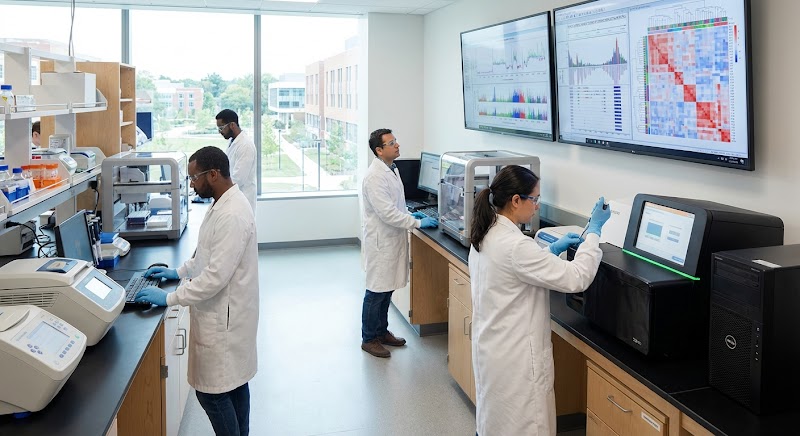
This is where cutting-edge technology meets biology. Machine Learning and Deep Learning models are indispensable for identifying the subtle patterns that distinguish cancerous tissue from healthy tissue. Companies like Illumina provide the sequencing hardware, while cloud players like AWS and Google Cloud offer the computational infrastructure for bioinformatics pipelines. Epigenetic technology doesn't just live in the wet lab; it lives in GPU clusters and classification algorithms.
This ecosystem creates a new class of assets: epigenetic data. Owning proprietary, well-annotated datasets correlated with clinical outcomes becomes a barrier to entry and a competitive moat as important as any patent on a molecule. The future battle will not just be about who has the best therapy, but about who has the best algorithm to predict the response to that therapy.
Off-Target: The Technical Debt of Synthetic Biology
No strategic analysis would be complete without a sober examination of the risks. The main concern with therapeutic epigenetic editing is permanence and specificity. Unlike a traditional drug that is metabolized and eliminated, an epigenetic modification can be stable and even heritable through cell division. An error—an 'off-target effect' that silences an essential gene—may not be easily reversible.
From a commercial standpoint, the path is equally treacherous. Drug development cycles are long and expensive, with very high attrition rates. An epigenetic therapy will face even more intense regulatory scrutiny than traditional gene therapies. Who will pay for treatments that can cost millions of dollars per patient? How will healthcare systems assess the cost-effectiveness of an intervention whose long-term effects are, by definition, unknown?
There is also the existential risk of the hype itself. By promising cures for aging and cancer, the industry creates expectations that, if not met within a reasonable timeframe for investors, could lead to a collapse in funding—the so-called 'AI winter' applied to biotechnology. The failure of one high-profile company could sour an entire sector's appetite for a decade.