Gemini 3 Flash: Analysis of Google's new artificial intelligence for speed and scale
Gemini 3 Flash: Analysis of Google's new artificial intelligence for speed and scale
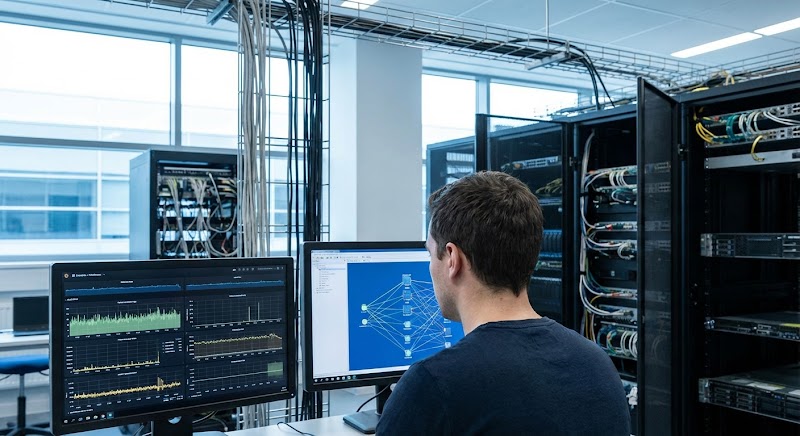
The Hidden Engine of Tomorrow: The Digital Agility Revolution No One Expected
The New Pulse of Digital: What Really Moves Our World?
Imagine for a moment that the backbone of our entire digital universe – from the smallest notification on your phone to the complex operations that sustain global economies – is about to undergo a profound metamorphosis. It's not a visible change, the kind that makes headlines with humanoid robots or flying cars. It's something much more subtle, silent, but with the capacity to redefine what we understand by 'intelligence' in the 21st century. We are talking about a race for something beyond pure raw power, an incessant search for the essence of agility, of the instantaneousness that makes the world spin faster.
For years, the dominant narrative about artificial intelligence has been about the quest for the digital 'superbrain.' Models that are increasingly larger, more complex, capable of performing feats that seemed like science fiction. But in our daily lives, in the pulse of every digital interaction, what do we really need? A philosopher capable of debating the mysteries of existence or a tirelessly fast and precise assistant who understands what you want before you even finish typing? The answer to this seemingly simple question is, in fact, shaping a new technological battlefield, one where speed has become the new metric of intelligence and the silence of efficiency is the sound of true innovation.
What moves us, therefore, is not just raw processing power, but the ability to transform that power into meaningful and immediate responses. It's the difference between having an entire library at your disposal and having exactly the sentence you need, at the exact moment your mind seeks it. This search for an almost precognitive agility is the new Holy Grail of technology, and its achievement promises to unlock a future where artificial intelligence is not just a tool, but an organic extension of our own cognition, as invisible as the air we breathe, but just as essential.
The Dilemma of Pondered Consciousness: When Power Meets Patience
For a long time, the vanguard of artificial intelligence was dominated by the idea that 'bigger is better.' More parameters, more layers, more data, more capacity for complex reasoning. It was a computational arms race, where the goal was to create models that could emulate, and even surpass, human cognitive abilities in high-level tasks. These advanced 'digital brains' are engineering marvels, capable of composing music, writing complex scripts, or diagnosing diseases with surprising accuracy.
However, with each advance in complexity came a cost. Not just financial, but operational. These gigantic models require a colossal amount of computational resources to function. Imagine an army of servers working in unison to answer a single question. The result? Answers that, although deep and precise, can take precious seconds to be generated, or that cost the equivalent of a small fortune with each interaction. For applications that require lightning speed – like a real-time customer service chatbot, a personalized recommendation system that adapts to every click, or voice assistants that instantly answer your questions – this 'patience' of the AI becomes a bottleneck, an insurmountable barrier.
The modern user experience is built on the expectation of instant gratification. Every millisecond of delay is perceived, subconsciously, as a failure. Developers found themselves facing a dilemma: sacrifice the sophistication of the AI for the sake of speed, or accept the slowness and exorbitant cost to maintain cutting-edge 'intelligence.' This technological crossroads required a new approach, one that did not discard depth, but prioritized agility, transforming the 'digital philosopher' into a 'tirelessly fast and cheap worker,' capable of executing essential tasks with unparalleled efficiency. It was necessary, then, to re-engineer intelligence itself, focusing not on what it *thinks*, but on the speed with which it *reacts*.
The Engineering of Speed: Google and the Invisible Heart of Decision
It was in this scenario of searching for efficiency that one of the world's greatest technological powers, Google, realized that the next frontier of artificial intelligence was not just in a model's ability to understand and generate knowledge exceptionally, but in its operational agility, in its capacity to be fast, lightweight, and accessible on a massive scale. The answer to this challenge came with the launch of Gemini 3 Flash.
Gemini 3 Flash is not just another large language model (LLM); it represents a fundamental philosophical and engineering shift. Think of it not as a supercomputer designed to solve the most complex problems in the universe in record time, but as a vast network of high-performance processors, each optimized for specific and rapid tasks. It's the difference between having a single Michelin-starred chef for every meal and having thousands of specialized chefs, each a master of a single preparation step, working in perfect sync to serve millions of delicious dishes in seconds.
The magic behind Flash lies in its optimization for 'high frequency and low latency.' What does this mean for the average reader? It means that requests (the questions, the commands, the information you send to the AI) are processed and answered almost instantly. 'Latency' is the time it takes for the system to react, and in the digital world, every millisecond counts. Flash is designed to minimize this time, turning waiting into a distant memory. And 'high frequency'? It means it can handle millions of requests per second, simultaneously, without choking. It's like a digital highway with infinite lanes, where traffic flows unimpeded.
This architecture allows Gemini 3 Flash to be incredibly economical in terms of operating costs. Fewer computing resources per interaction translate into lower costs for developers and, consequently, more opportunities to innovate. This is not just a technical breakthrough; it is a democratization of cutting-edge AI, allowing small startups and large companies to integrate artificial intelligence into their applications without the need for stratospheric budgets. It's the promise that AI can finally be as ubiquitous and accessible as electricity.
The Invisible Fabric: How Latency Shapes Our Lives
The word 'latency' may sound like technical jargon, but its impact is felt by all of us every moment we interact with technology. It's the small delay between you touching the screen and the app's response, the brief silence before your voice assistant replies, or the micro-pause in a video stream. These milliseconds, imperceptible in isolation, add up to shape our perception of fluidity, efficiency, and ultimately, the quality of our digital experience.
With high-latency AI models, a conversation with a chatbot can feel forced, with pauses that break the natural rhythm of human interaction. A real-time translation could become impractical. An interactive game that uses AI to generate dynamic scenarios would be frustrating. Gemini 3 Flash attacks the heart of this problem, allowing artificial intelligence to integrate so seamlessly that it becomes almost invisible. It transforms these awkward pauses into a continuous flow, where the machine seems to anticipate your needs.
Think of the implications for something as simple as a recommendation system. Instead of suggesting products or content based on a static history, a low-latency AI can analyze your behavior in real-time, adapting suggestions as you browse, click, and interact. It's like having a personal shopper who not only knows your past preferences but also reads your mind in the present, understanding your mood changes and interests instantly. This ability to adapt in milliseconds creates a hyper-personalized experience that was, until now, a distant dream, reserved only for systems of the highest cost and complexity.
Flash not only accelerates the response, it accelerates the very possibility of interaction. It allows the AI to be 'always on, always ready,' like a reflex, not a time-consuming thought process. For the average user, this means less frustration, more fluidity, and the feeling that technology truly 'understands' and 'keeps up' with their pace, making the barrier between human and machine increasingly thin. Ultimately, latency shapes our patience and our digital satisfaction, and mastering it is a crucial step toward a truly interactive future.
Unlocking New Worlds: The Unexpected Frontiers of Agility
The true revolution of Gemini 3 Flash manifests not just in speed or cost alone, but in the new frontiers it unlocks. By drastically reducing resource requirements and response time, Google is paving the way for a proliferation of AI applications that were previously unfeasible or economically prohibitive. It's like the invention of the transistor, which made electronics accessible and compact, or the advent of broadband internet, which transformed how we consume information.
Imagine the field of personalized education. With Flash, a student can have an AI tutor that answers questions instantly, adapts educational material in real-time based on performance and learning style, and even generates personalized exercises on the spot. This fluid and immediate interaction transforms education from a 'one-size-fits-all' model to a truly individualized and dynamic experience, all without the prohibitive costs of dedicated human tutors.
In digital marketing, the agility of Flash allows for dynamic content generation. Instead of static campaigns, companies can create advertising messages, offers, and landing pages that adapt in milliseconds to the user's profile, context, and even mood at the moment of interaction. This isn't just segmentation; it's real-time contextual hypersensitivity, turning every touchpoint into a unique and engaging conversation.
Furthermore, Flash has the potential to democratize access to cutting-edge AI for thousands of developers and small businesses. If before only tech giants could afford the computing costs to integrate powerful models, now, with the economy of scale and efficiency of Flash, startups can build innovative products that use advanced AI without exhausting their budgets. This fosters a more vibrant and diverse innovation ecosystem, where good ideas can flourish without the financial or technical barriers that once restricted them.
It's the missing step for AI to cease being an 'elite technology' and become a 'common utility,' as integrated into our infrastructure as water and electricity. By making artificial intelligence cheaper and faster, Flash is not just improving what already exists; it is empowering a new generation of creators to imagine and build futures that were once impossible, where AI is a flexible and ubiquitous tool, always ready to serve.
The Geopolitics of Milliseconds: The Power of a Flexible Infrastructure
On the chessboard of technological geopolitics, the race for supremacy in artificial intelligence is often seen as a contest for raw computing power and for increasingly 'intelligent' models. However, Gemini 3 Flash and its emphasis on efficiency and agility introduce a crucial strategic dimension: that of the power of flexible infrastructure and the democratization of access to AI.
A country or company that can offer cutting-edge AI more cheaply and quickly holds an immense competitive advantage. It's not just about having the 'smartest' AI, but about having the most 'useful' and 'available' AI. This directly impacts a nation's ability to innovate, its companies' ability to remain competitive, and its citizens' access to advanced technologies. The ability to deploy AI at scale, without prohibitive energy or hardware costs, becomes a strategic differentiator as important as the algorithm itself.
Furthermore, the energy efficiency of models like Flash addresses a growing concern: the environmental impact of AI. Training and running gigantic models consume astronomical amounts of energy, equivalent to the consumption of small cities. Developing models that deliver high performance with a much smaller energy footprint is not only an economic victory but also a contribution to global digital sustainability. This translates into a greener, more accessible AI, and therefore, more adaptable to a resource-conscious future.
The real battle for AI supremacy may not be won by the model that writes the most complex poem, but by the one that can optimize millions of real-time interactions with the lowest cost and environmental impact. Flash is not just a technological innovation; it is a fundamental piece in building a more robust, resilient, and globally accessible digital infrastructure, redefining the rules of the game and ensuring that the power of AI is not concentrated only in the hands of a few, but distributed more equitably. This is the silent geopolitics of milliseconds, where agility is the key to dominance and influence.
The Post-Flash Future: A More Connected and Immediate World
As we look to the horizon, the impact of a technology like Gemini 3 Flash extends far beyond cost spreadsheets and latency charts. It points to a future where artificial intelligence is not a fascinating novelty, but a component as intrinsic to our reality as electricity or the internet. AI will become increasingly imperceptible, working behind the scenes to make every digital interaction more fluid, intuitive, and instantaneous.
Imagine smart cities where traffic flow is optimized in real-time based on millions of sensor data points, responding to every change in condition without delay. Think of health assistants that discreetly monitor your well-being, alerting you to anomalies with the same instantaneity as a reflex. Envision augmented and virtual reality experiences that are so responsive that the line between the digital and the physical dissolves completely, thanks to the ability to process and render complex environments in milliseconds.
However, with this ubiquity and agility, new responsibilities and ethical considerations arise. How will we ensure that this omnipresent AI is fair, transparent, and secure? How will we protect privacy in a world where real-time personalization becomes the norm? These are the questions that the post-Flash era forces us to face, as technology becomes an increasingly intimate extension of our lives.
Gemini 3 Flash is not the end of the line, but a catalyst. It represents a strategic fork in the evolution of AI, where the quest for maximum intelligence is complemented, and in many cases surpassed, by the demand for maximum efficiency. It pushes us toward a future where artificial intelligence is less a laboratory prodigy and more an essential utility, a hidden engine that animates the digital fabric of our tomorrow, making the world more connected, more immediate, and inevitably, more complex. The true wonder will not be what AI can do, but how it integrates so seamlessly that we don't even notice it's there, shaping every millisecond of our digital existence.