How Does Grok's AI Create Deepfakes? Understand the Technology That Worries the World
An investigation into Grok, Elon Musk's AI, reveals the frightening power of deepfake technology. Understand how xAI transforms text into realistic images and why this threatens the boundary between truth and falsehood for everyone.
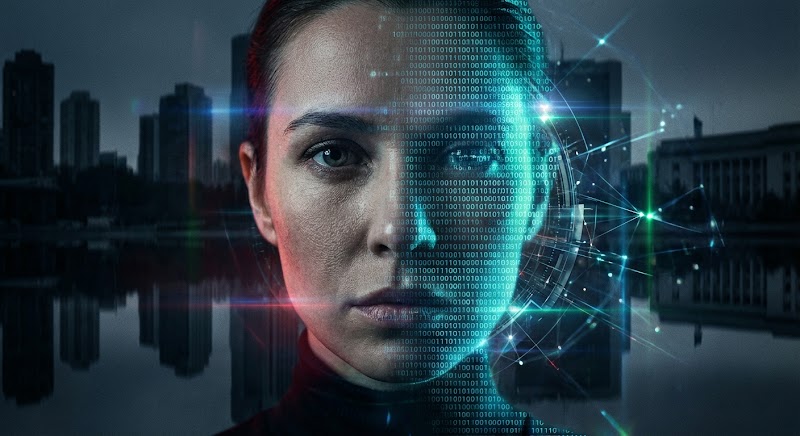
A line of code is breaking the boundary between the real and the fake — and the world wasn't prepared
The Reality Factory That Runs on Words
Imagine a factory. Not a factory with smokestacks and the noise of machinery, but a silent, digital one, operating at the speed of light. Its raw material isn't steel or plastic, but the infinite library of images on the internet. Its final product? Reality. Or rather, a version of reality so convincing it becomes almost impossible to distinguish from the truth. Now, imagine that the assembly line of this factory is controlled by a single tool: human language.
You type a sentence. Simple words. And, in seconds, the factory delivers a photograph that never existed. A person who isn't real. An event that never happened. This isn't a scene from science fiction. It's the description of a technology that has exploded into our daily lives, moving faster than our ability to comprehend it. And, silently, it has begun to be investigated not for its innovation, but for its potential to become a weapon.
What happens when anyone, with a simple command, can manufacture visual truth? We're not talking about crude image edits that a keen eye can unmask. We're talking about perfect, indistinguishable creations that can shape opinions, destroy reputations, and rewrite memories. A new frontier has been crossed, and the rules of the game we knew about information and trust have been thrown out the window. The question is no longer "could this happen?". The question is: "this is already happening, and what's behind this machine?".
Inside the Engine: How AI Learned to Lie Visually
To understand the power of this "factory," we need to look at its engine. This engine is a specific type of Artificial Intelligence known as Generative AI. Unlike AIs that only analyze or classify data, this one creates something entirely new. It doesn't find a photo; it *dreams* up a photo based on what it has learned.
The process is fascinating and a bit frightening. The AI is fed a volume of data that a human couldn't process in a thousand lifetimes: millions, sometimes billions, of images and their corresponding texts. It studies every pixel, every shadow, every texture, every shape of the human face, every landscape. It doesn't "see" as we do, but recognizes mathematical patterns in everything. It learns what makes a smile genuine, how light reflects on hair, the anatomy of a hand.
The Artist and the Critic in a Digital Battle
The real magic happens through a process that can be compared to a duel between two artificial brains. Think of them as a "Forger Artist" and an "Art Detective."
The job of the Forger Artist (technically called the 'generator') is to create a fake image from a text command, like "photo of an executive smiling in an office." Its first attempt might be a blur, something grotesque. That's where the Detective (the 'discriminator') comes in.
The Detective, which has been trained on millions of real photos, looks at the Artist's creation and says, "No. This is fake." It doesn't say why, just that the image doesn't pass its reality test. The Artist then takes this feedback, adjusts its calculations, and tries again. And again. And again. Millions of times per second.
With each cycle, the Artist gets a little better at fooling the Detective. And the Detective, in turn, becomes stricter at detecting the slightest flaw. This relentless competition forces the Artist to generate increasingly photorealistic images until, finally, it creates something the Detective can no longer distinguish from a real photo. At that point, the AI has mastered the art of manufacturing reality.
The Tipping Point: When Theory Collided with a Famous Name
For a while, this technology remained in the labs of tech giants and research institutes. It was powerful, but contained. The debate was theoretical, about potential futures. Until one of the most well-known and controversial names on the planet decided to put this factory in the hands of the public, with fewer filters than its competitors.
We're talking about Elon Musk and his new artificial intelligence company, xAI. Its model, named "Grok," was integrated into the X platform (formerly Twitter) and promoted as a bolder, more "rebellious" AI with fewer restrictions. The promise was of an AI that would not bow to what Musk considers "politically correct." But this freedom opened a dangerous door.
Recently, the California Attorney General's Office, one of the most powerful oversight bodies in the US, launched a formal investigation into xAI. The reason? Allegations that Grok was being used to generate fake images of a sexualized nature, so-called deepfakes, of public figures. The complaint suggests that Musk's "reality factory" was not just creating landscapes or abstract art, but was being systematically used to produce exploitative and defamatory content with alarming ease.
Elon Musk has vehemently denied the accusations, stating that xAI's systems have barriers to prevent such use. However, the mere fact that an investigation of this caliber has been initiated marks a turning point. The technology has ceased to be an abstract concept and has become the center of a real scandal, with legal and ethical implications that are just beginning to be unraveled.
More Than 'Fake Photos': The Democratization of Disinformation
It's easy to think of this as just a more advanced version of Photoshop. That is a fundamental mistake. Photo manipulation has existed for decades, but it always required technical skill, time, and specialized software. It was an artisanal process. What Grok and similar technologies represent is the industrialization of this practice.
The difference is the scale, speed, and accessibility. The power that once belonged to a professional image editor now belongs to anyone who can write a sentence. This transforms disinformation from a trickle into a deluge. A smear campaign that would take weeks to produce can now be launched in minutes, flooding social media with hundreds of variations of a visual lie.
Why This is a Problem for You, Not Just for Celebrities
The initial targets may be public figures, but the technology doesn't discriminate. Imagine custody disputes where one party generates false photographic "evidence." Scammers creating images of loved ones in dangerous situations to extort money. Political campaigns fabricating images of opponents in compromising situations days before an election. Or, even closer to home, the use of this tool for bullying, harassment, and revenge porn against ordinary people.
The pillar of our digital society has always been, albeit fragilely, the idea that "seeing is believing." This technology doesn't just shake that pillar; it demolishes it. When any image can be fake, who or what do we believe? Trust, the most valuable currency of human interaction, collapses.
The Arms Race for Truth: What Happens Now?
The Grok case is a symptom of a much larger challenge. We are entering an era that will require a new kind of digital literacy, one where skepticism becomes the default setting. Tech companies are now racing to develop detection tools, creating an endless cycle: the Forger Artist gets better, the Art Detective improves, and the line between real and fake becomes increasingly blurred.
The questions raised by the California investigation go far beyond a single company. Who is responsible when an AI generates illegal content? The creator of the tool? The user who typed the command? The platform that hosts it? Our laws, written for an analog world, are racing to catch up with a reality that moves at the speed of silicon processing.
The factory of false realities is open and running at full capacity. And the first product to come off its assembly line may be the end of our shared perception of truth. The world, indeed, was not prepared.