The Banned Chip and Its 'Legal' Version: How Technology Redefines Power
A superpower banned the export of the century's most strategic technology. The industry's response was to create an alternative version, slightly different, but legal. Discover how this piece of silicon is redrawing the map of geopolitics and innovation.
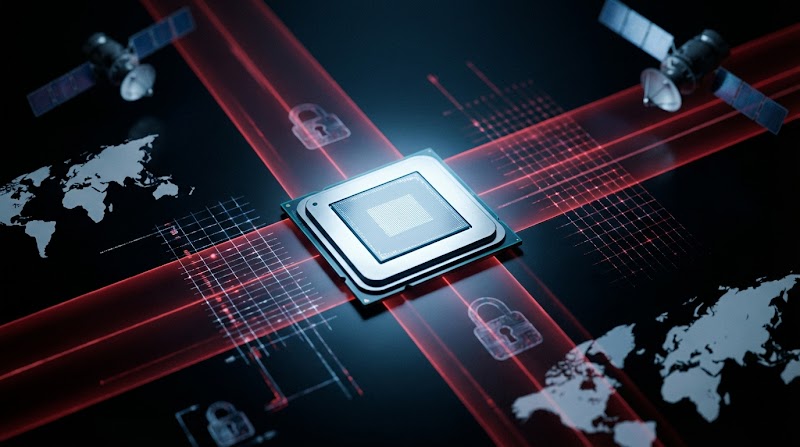
Imagine a global race, the most important of our century. But the competitors are not vying for gold, oil, or territory. They are vying for control over a new type of engine—one that doesn't burn fuel, but processes thoughts. An engine capable of learning, creating, and deciding. This technology, encapsulated in tiny pieces of silicon, has become so powerful that the United States government decided to turn it into a weapon of war, banning the export of its most potent models to its greatest strategic rival.
The logic behind the ban was simple and brutal: to cut off the adversary's technological oxygen. Without access to the most advanced 'brains,' the target country's development of cutting-edge artificial intelligence, autonomous cars, medical diagnostics, and military systems would be severely slowed. The measure created an immediate vacuum in the market, leaving the world's most populous nation and one of its largest economies desperate for a solution. It was a barrier that seemed insurmountable, a technological blockade in the middle of the digital age.
This is where the story takes a surprising turn. The company at the center of this storm, the American firm Nvidia, the undisputed leader in manufacturing these AI 'brains,' didn't just watch its largest market evaporate. In a move of pure corporate and geopolitical strategy, it developed a solution. The company created a new chip, named the H200, designed with an ingenious purpose: to be powerful enough to meet China's needs, but with technical specifications that placed it a millimeter below the red line drawn by American sanctions. It wasn't the world's most powerful chip, the H100, which had been banned. It was something different: a cutting-edge weapon, carefully calibrated to be 'legal'.
To understand the genius and tension behind the H200, we first need to demystify what an 'AI chip' is. Think of your computer's processor (the CPU) as a math genius who solves one complex problem at a time, sequentially and incredibly fast. It's perfect for opening a program or calculating a spreadsheet.
An AI chip, technically a data center GPU (Graphics Processing Unit), is different. It's not a lone genius; it's a stadium with tens of thousands of simpler 'mini-brains' working at the same time, in parallel. This ability to perform thousands of calculations simultaneously is useless for opening your email, but it's exactly what artificial intelligence needs to learn.
The 'learning' of an AI, like ChatGPT or an image recognition system, involves analyzing millions of examples (texts, photos, data) at once and adjusting tiny connections between its artificial neurons. The AI chip is the hardware that allows this 'symphony' of calculations to happen at high speed. The more powerful the chip, the faster the AI learns, and the more complex the problems it can solve. That's why these chips are the most strategic resource on the planet today: whoever has the best and fastest chips, builds the smartest and most powerful AI.
The manufacturing of these components is one of the most complex feats in human history, which explains why so few can do it. The process involves a global supply chain so delicate it resembles a choreography. The design is done by companies like Nvidia in the US. The machines that 'print' the circuits on silicon wafers, using extreme ultraviolet light, are made almost exclusively by a single company in the world, ASML, in the Netherlands. And the final assembly, transforming the design into a physical chip, is dominated by a giant in Taiwan, TSMC.
This interdependence is what gave the United States its trump card. By controlling access to American design and intellectual property, the government was able to create a chokepoint. The sanctions were not based on banning 'AI chips' generically, but on defining very specific technical limits. The main criterion was the 'data transfer rate' or 'interconnect bandwidth'—essentially, the speed at which the chips can 'talk' to each other when grouped in supercomputers.
AI supercomputers don't use one, but thousands of these chips working together. The speed at which they exchange information is crucial. If communication is slow, the entire system slows down, no matter how powerful each individual chip is. The US government bet that by limiting this communication speed, it would prevent China from building the massive supercomputers needed to train the world's most advanced AI models.
And it was exactly in this loophole that Nvidia worked. The banned chip, the H100, was a performance monster in every sense, including its very high interconnect speed. The new chip, the H200, was designed differently. In an engineering irony, it has even more high-bandwidth memory (HBM3e) than its older brother, which makes it exceptionally good for certain AI tasks that require access to large volumes of data. However, its chip-to-chip communication speed was deliberately reduced to fall below the limit imposed by the sanctions.
The result is a fascinating piece of technology. The H200 is like a race car with the most modern engine in the world, but with a transmission system that prevents it from exceeding a certain maximum speed. For China, it's a bittersweet solution. On one hand, it's an immense relief. The chip allows its tech companies, like Baidu, Alibaba, and Tencent, to continue developing their AI projects without a total interruption. It's an oxygen flow that keeps the patient alive and functioning.
On the other hand, it's a constant reminder of their vulnerability. They are receiving powerful technology, but it's not the absolute cutting edge. It's the export version, the 'compliance' edition. For a country with the stated ambition of becoming the world leader in AI by 2030, depending on a 'limited' version of foreign technology is an uncomfortable position. This fuels, with even more urgency, China's multi-billion dollar effort to achieve self-sufficiency, investing heavily in local companies like Huawei so that one day they can design and manufacture their own cutting-edge chips, free from any external control.
For Nvidia, the strategy is a masterclass in navigating modern geopolitics. The company complies with American law to the letter, avoiding sanctions and problems with Washington. At the same time, it keeps its foot in the door of the giant Chinese market, which represents a significant portion of its revenue. If Nvidia simply abandoned China, competitors might try to fill that gap, and the Chinese government would accelerate its domestic development programs even more. With the H200, Nvidia keeps China as a customer, sells a very high-value product, and, in a way, keeps the Chinese tech ecosystem tied to its hardware.
The impact of this saga goes far beyond company spreadsheets or the corridors of power. The dispute for control of these chips defines who will lead the next industrial revolution. Artificial intelligence is not an isolated technology; it is the foundation for almost all other innovations. Cars that drive themselves need these chips to process the world in real time. The discovery of new drugs and vaccines is accelerated by AIs that simulate molecular interactions on supercomputers powered by these chips. Even national security is at stake, with the development of autonomous drones, surveillance systems, and cyber defense.
The case of the H200, therefore, is a perfect microcosm of the new Cold War. It is not a dispute fought with armies on a visible battlefield, but with engineers in labs, lawyers in boardrooms, and politicians defining technical specifications in official documents. The weapon is not a missile, but a piece of silicon engraved with circuits on the scale of atoms. And power is not measured just by military strength, but by the ability to process data and turn information into intelligence.
Ultimately, the story of the 'legal' chip that bypassed a geopolitical ban teaches us a fundamental lesson about the world we live in. The architecture of global power is no longer defined merely by borders and treaties, but by the architecture of microchips. To understand the journey of this small silicon object, from its design in California to its 'calibrated' version for the Chinese market, is to understand the invisible forces shaping our future and the true battlefield for control of tomorrow.