Marketing Mix: Why the 4 Ps Died and What Replaces Them
An analysis of the obsolescence of the traditional marketing mix. See how data, AI, and the JCPenney case redefine strategy beyond the 4 Ps.
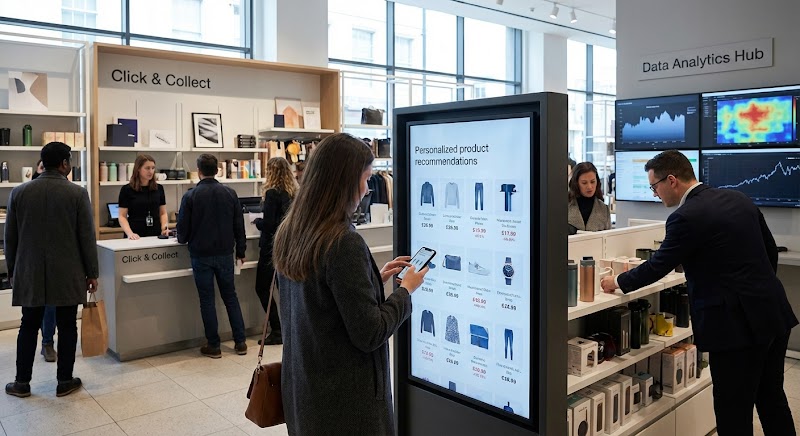
Discussing the 4 Ps of marketing in any modern meeting room is a symptom of strategic inertia. The framework conceived by Jerome McCarthy in the 1960s, useful for an era of mass production and one-way media, today represents little more than a historical artifact. Insisting on its literal application is like trying to navigate São Paulo traffic using a paper map from 1980. Does it work? Perhaps, but the latency and inefficiency are fatal.
The true nature of the contemporary marketing mix is no longer a set of static levers, but a dynamic operating system, fueled by first-party data and orchestrated by algorithms. The recent case of JCPenney, in its revival attempt, is not a story about a brilliant advertising campaign or a new discount scheme. It is a narrative about the fundamental re-engineering of its marketing mix, transforming it from a monolithic model to a data-driven microservices architecture.
The obsolescence of the 4 Ps is not semantic; it's functional. 'Place' has been pulverized by the concept of 'omnichannel.' 'Price' is no longer a fixed value but a dynamic variable calculated in real-time. Mass 'Promotion' has given way to hyper-personalization. And 'Product' is now co-created with the consumer, with feedback loops that shape inventory and development. Ignoring this systemic mutation guarantees irrelevance and, consequently, a declining position on the SERP of real life: the market.
From Monolith to Algorithm: The Decomposition of the Classic Mix
The transition from the traditional to the contemporary model can be seen as the evolution of computing: from centralized mainframes to distributed cloud architectures. The marketing mix is no longer a checklist but a real-time dashboard. The change is structural and requires a complete reassessment of its components, which now operate less like pillars and more like interconnected nodes in a neural network.
To visualize the depth of this disruption, a direct comparison is necessary. The old model was prescriptive and company-centric; the new one is predictive and customer-centric, or more precisely, centered on the customer's 'search intent,' whether explicit or latent.
| Characteristic | Classic Marketing Mix (4 Ps) | Dynamic Marketing Mix (A.D.A.P.T. Model) |
|---|---|---|
| Central Pillar | Product | Audience (First-Party Data) |
| Distribution | Place | Distribution (Omnichannel & Predictive Logistics) |
| Value | Price | Access (Dynamic Pricing & Subscription Models) |
| Communication | Promotion | Personalization (Automation and AI at scale) |
| Operation | Static, campaign-based | Time (Real-Time) (Feedback loops and continuous optimization) |
This new model, which we can call A.D.A.P.T., shifts the strategic axis. The company no longer 'pushes' a product to the market; it 'pulls' insights from the audience to adapt its offering, distribution, pricing, and communication in a perpetual cycle.
JCPenney: A Laboratory for the Post-Digital Mix
JCPenney's effort to rise from the retail abyss is a fascinating case study on the application of these new principles. The 'Make It Count' strategy is not just a slogan. It is the verbalization of an operational shift. By focusing on middle-income customers and diversifying its portfolio with brands like Jason Bolden's, the company is, in practice, rebuilding its 'Audience' pillar. They are abandoning the chimera of 'being everything to everyone' in favor of a well-defined customer cluster whose behavior can be modeled.
Its pricing strategy, which historically oscillated between aggressive discounts and unsustainable full prices, now seeks a smarter balance, likely supported by pricing engines that analyze demand elasticity and purchasing behavior. 'Distribution' is the classic omnichannel challenge: integrating the physical store experience with the fluidity of e-commerce, ensuring that inventory is visible and accessible at all touchpoints. 'Personalization' is manifested in CRM efforts and the loyalty program, which are the main sources of first-party data to fuel the entire system.
The Technology Stack Behind the Strategy
None of these changes would be feasible without a robust technological infrastructure. Talking about the new marketing mix is, inevitably, talking about Customer Data Platforms (CDPs), data lakes, machine learning-based recommendation engines, and marketing automation. JCPenney's ability to execute this turnaround depends less on its advertising creativity and more on the quality of its data and the low latency of its systems.
This is where a business's authority is built or destroyed. The ability to unify online behavior data, in-store purchase history, and customer service interactions into a single customer profile is what enables personalization at scale. A failure at any of these integration points creates a fragmented customer experience and increases the churn rate. The marketing mix, therefore, has become as much a data engineering problem as a business strategy one.
The Technical Debt of the New Marketing Mix
However, the adoption of this algorithmic model is not without profound risks. The dependence on data introduces significant vulnerabilities. Dynamic pricing algorithms can be perceived as unfair or discriminatory, leading to reputational crises. Hyper-personalization can cross the fine line of privacy, especially in a post-third-party cookie world and with regulations like GDPR becoming stricter.
Furthermore, there is the risk of operational complexity. Managing an integrated marketing technology ('martech') stack is expensive and requires specialized talent – data scientists, marketing engineers, CX analysts. For a company like JCPenney, struggling to emerge from a financial crisis, the investment in technology and personnel can be a heavy burden. The 'subversive' strategy can easily turn into technical and financial debt if the execution is not flawless and if the ROI does not materialize quickly.
The forward-looking vision for the marketing mix is clear: it is no longer a set of marketing variables but the central nervous system of the organization. The companies that will thrive are not those that have memorized the 4 Ps, but those that have built a resilient data architecture and an agile organizational culture to interpret and act on market signals in real-time. The question for JCPenney, and for everyone else, is not whether the marketing mix has changed, but whether the entire organization is capable of keeping up with this transformation.