What is the Great Filter? The Answer to the Fermi Paradox
Why haven't we found aliens? The Great Filter theory suggests a frightening answer: a barrier may extinguish civilizations. Have we already passed it?
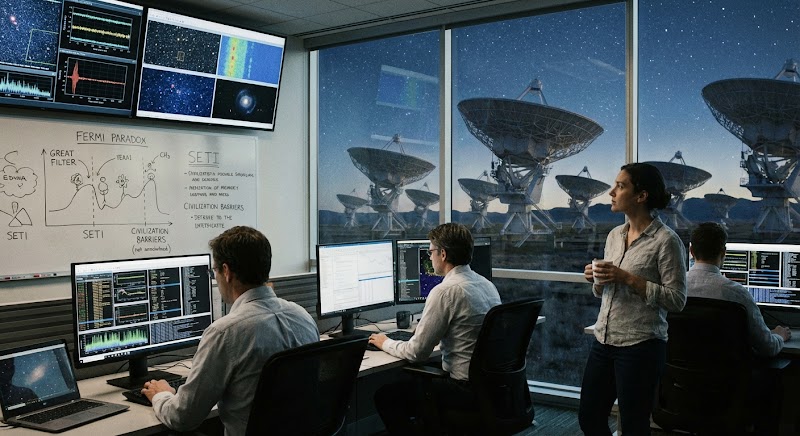
Have you ever looked up at the night sky and wondered, "Where is everybody?"
If so, you're not alone. In 1950, physicist Enrico Fermi asked the same question during a lunch, giving rise to what we now call the Fermi Paradox. The logic is simple and brutal: our universe has billions of galaxies, each with billions of stars, many with planets. Statistically, alien life should be common. So, why don't we see ships, pick up signals, or find any evidence at all?
The cosmos is frighteningly quiet. And the Great Filter theory offers an explanation as brilliant as it is terrifying.
What is the Great Filter, Anyway?
Imagine the evolution of life as a long and dangerous obstacle course. The Great Filter isn't a physical wall in space, but rather one or more evolutionary or technological barriers that are extremely difficult to overcome.
It's a concept proposed by economist Robin Hanson, who suggests that somewhere between non-living matter and a civilization capable of colonizing galaxies, there exists a challenge so monumental that almost no one (or perhaps no one at all) can get past it.
The silence we hear from the universe might actually be the sound of a cosmic cemetery. The sound of countless species that tried but failed at some critical point in this journey.
The Trillion-Dollar Question: Is the Filter Behind Us or Ahead of Us?
This is the essence of the debate and what makes this theory so fascinating. There are two main possibilities, each with gigantic implications for the future of humanity.
Scenario 1: The Great Filter is in our past (The good news!)
If the filter is behind us, it means humanity has already overcome the most unlikely and dangerous step. We are special. Perhaps the emergence of life from inanimate matter (abiogenesis) is nearly impossible. Or maybe the leap from a simple cell to a complex (eukaryotic) cell is the true cosmic miracle.
In this case, the silence of the universe isn't a warning, but an empty stage waiting for us. We are the first. The galaxy is ours to explore.
Scenario 2: The Great Filter is in our future (The terrible news)
This is the hypothesis that keeps scientists up at night. What if the emergence of intelligent life is common, but something always prevents it from going too far? If that's the case, the barrier is still ahead of us, waiting.
What could it be? The possibilities are grim:
- Technological Self-Destruction: Nuclear weapons, lab-created pandemics, a runaway artificial intelligence.
- Environmental Collapse: A civilization becomes so advanced that it consumes its planet to exhaustion, causing irreversible climate change before it can become multi-planetary.
- Dangerous Discoveries: Perhaps there is some knowledge (a type of physics, a technology) that, once discovered, inevitably leads to destruction.
In this scenario, finding microbial life on Mars would be terrible news. It would mean that the emergence of life is not the filter, making it more likely that the real challenge lies, menacingly, ahead of us.
Deciphering the Barriers: Where Might the Filter Be?
To better understand, let's map out the possible 'boss levels' in the journey of life. Which one seems the hardest to beat?
| Possible Filter | Barrier Description | Have We Passed It? 🤔 |
|---|---|---|
| Abiogenesis | The emergence of life from non-living matter. An event of chemistry and luck of cosmic proportions. | Probably Yes. Life arose on Earth relatively early in its history. |
| Complex Cells | The leap from prokaryotes (bacteria) to eukaryotes (cells with a nucleus). It took almost 2 billion years! | Yes. We are living proof. It was a gigantic and perhaps very rare step. |
| Intelligence | The development of a brain capable of creating tools, complex language, and science. | Yes. We are here, thinking about it. But is it a guaranteed event? |
| Sustainable Technology | The ability of a civilization to advance without destroying its own planet or itself. | Inconclusive. This is our challenge NOW. We are in the middle of the test. |
| Interstellar Colonization | Mastering the physics and engineering to travel to and establish self-sufficient colonies in other star systems. | Not Yet. This could be the final test, the last and greatest of the filters. |
What If the Answer Is Something Else? Behind the Silence
Of course, the Great Filter isn't the only explanation for the silence. There are other fascinating hypotheses:
- The Zoo Hypothesis: Super-advanced civilizations exist, but they observe us from a distance, treating Earth like a cosmic nature reserve, without interfering.
- We Are Too Early: The universe is still young. Perhaps we are one of the first, if not the first, civilizations to reach this point. The cosmic party hasn't started yet.
- They Are Hiding: Perhaps the universe is a dangerous place, and the smartest strategy is not to announce your presence to potential cosmic predators. Silence would be a matter of survival.
How the Great Filter Affects Your Life (Yes, Yours!)
It may seem like an abstract concept, but the Great Filter redefines the importance of our daily actions. It transforms problems like climate change, political polarization, and the risk of nuclear war from mere geopolitical challenges into a possible final test for the species.
Every effort to create a more sustainable, cooperative, and secure future isn't just about improving our lives. From the perspective of the Great Filter, it's an attempt to disarm the trap that may have annihilated countless other civilizations.
Investing in space exploration, like the plans to colonize Mars, takes on a new meaning: it's not just curiosity; it's creating a 'backup' for humanity. It's our insurance policy against a filter that could close on us at any moment.