AWS Inferentia 3: Cost Reduction for LLMs in Production
AWS Inferentia 3: Cost Reduction for LLMs in Production
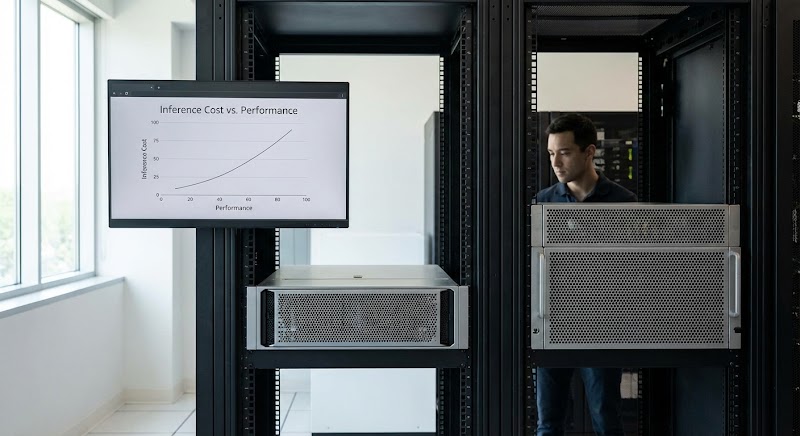
The AI infrastructure narrative has been dictated for years by a single protagonist: NVIDIA. Its GPUs became the undisputed foundation for training and inference, creating a de facto 'NVIDIA tax' on every generative AI application. Companies paid, silently complaining about margins squeezed by exorbitant hardware costs, because there was no viable alternative for performance at scale. This status quo has just been fractured.
The launch of the Inferentia 3 chip by Amazon Web Services is not just an incremental hardware update; it's a calculated strategic attack on the economics of generative AI. By promising drastic cost reductions specifically for inference – the operational phase where most AI applications live and burn cash – AWS is challenging the core of NVIDIA's market dominance.
This move signals a fundamental shift from a monolithic hardware dependency to a diversified, cost-driven infrastructure strategy. For any CTO or Head of Product building with LLMs, the landscape has just become significantly more complex and, potentially, more profitable.
The Architecture of Disruption: Deconstructing Inferentia 3
What AWS has designed is not another GPU competitor. Inferentia 3 is an ASIC (Application-Specific Integrated Circuit), a piece of silicon meticulously designed for one primary function: running trained neural networks with maximum efficiency. Unlike a general-purpose GPU, which must balance graphics rendering, scientific computing, and AI training, Inferentia 3 eliminates legacy overhead to focus purely on inference throughput and cost-performance.
The architecture centers on an array of second-generation Neuron Cores. These cores are optimized for the core mathematical operations of LLMs, particularly large matrix multiplications and transformer attention mechanisms. AWS claims native support for a range of data types, including FP8 and INT4 quantization, which allows models to run with a smaller memory footprint and lower latency without significant accuracy degradation. This is a critical feature, as it directly reduces the operational cost per generated token.
Furthermore, the chip integrates a dedicated high-bandwidth memory system and a proprietary interconnect, NeuronLink, enabling the creation of massive, cohesive 'super-accelerators' by connecting thousands of chips. This design directly targets the challenge of running foundational models with hundreds of billions of parameters, which often need to be split across multiple processors. The promise is near-linear scalability without the performance bottlenecks seen in more generic cluster solutions.
To visualize the impact, a direct comparison with the incumbent and the previous generation is enlightening:
| Key Metric | NVIDIA H100 (PCIe) | AWS Inferentia 2 | AWS Inferentia 3 (Estimated) |
|---|---|---|---|
| Architectural Focus | Training & Inference (GPU) | Inference (ASIC) | LLM Inference (ASIC) |
| Cost/Million Tokens | Baseline (High) | ~40% Reduction vs GPU | ~70-80% Reduction vs GPU |
| Typical Latency (p99) | Low, but at a high cost | Medium | Ultra-low (optimized) |
| Software Support | Dominant (CUDA) | Limited (Neuron SDK) | Expanded (Neuron SDK 2.0) |
The table reveals AWS's strategy: not to compete in training, where NVIDIA's CUDA ecosystem is an almost insurmountable moat, but to redefine the battlefield for production inference, where TCO (Total Cost of Ownership) is king.
Implications for the AI and Technology Sector
The launch of Inferentia 3 reverberates far beyond AWS data centers. It attacks the cost structure of the entire AI software ecosystem. SaaS companies selling 'copilots,' code assistants, or content generation platforms see their gross margins directly tied to the cost of inference. A 70% reduction in this cost is not an optimization; it's a business model overhaul.
This democratizes scale. Until now, only players with massive capital could dream of deploying state-of-the-art models to millions of users in real-time. With the altered inference economics, startups and medium-sized companies gain access to computational power that was previously prohibitive. This could trigger a new wave of innovation in custom, low-latency AI applications, from more responsive customer service agents to real-time generative design tools.
Cloud infrastructure is also entering a new phase. The era of the 'GPU monoculture' is ending. Cloud architects now need to think in a heterogeneous environment, where training workloads run on NVIDIA GPUs, while mass inference is directed to specialized ASICs like Inferentia 3. This added complexity is the price of efficiency. The decision of which hardware to use will cease to be a default and will become a strategic choice based on performance, cost, and the risk of vendor lock-in.
Risk Analysis and the Software Moat
The AWS narrative is powerful, but the devil is in the implementation details. The biggest obstacle to Inferentia 3 adoption is not the hardware, but the software. NVIDIA's CUDA ecosystem has been built over more than a decade. It is robust, familiar to millions of developers, and supports virtually any machine learning framework.
The AWS Neuron SDK, while improved, is still a proprietary and niche ecosystem. Migrating complex, CUDA-optimized models to Neuron is not a trivial process. It requires re-engineering, extensive testing, and team upskilling. The performance benchmarks released by AWS were certainly achieved on models highly optimized for its platform. Performance on less common open-source models or custom architectures remains an unknown.
Furthermore, AWS's strategy trades one type of dependency for another. By optimizing the AI stack for Inferentia, companies delve deeper into the AWS ecosystem, increasing the cost and complexity of a future migration to another cloud or to on-premise infrastructure. Relief from the 'NVIDIA tax' may come at the cost of a tighter embrace from AWS, a classic vendor lock-in dilemma. The risk is real and needs to be quantified in any TCO analysis.
The Verdict: Next Steps for Technology Leaders
Ignoring this announcement is not an option. The economics of generative AI have been officially put in check. Complacency with GPU-based infrastructure costs has become a strategic vulnerability.
In the next 48 hours: CTOs and VPs of Engineering should instruct their MLOps and FinOps teams to dissect the Inferentia 3 whitepaper. The immediate goal is to understand the limitations of the Neuron SDK and identify which models in the current portfolio are the most likely candidates for a successful migration. Simultaneously, it's time to get in line for access to the private preview program.
In the next 6 months: The focus should be on empirical validation. Run a pilot project with a non-critical but representative inference workload. The goal is not just to replicate AWS's benchmarks, but to understand the real cost of migration in engineering hours, the team's learning curve, and performance in real-world scenarios. Build a 24-month comparative TCO model that includes not only the computational cost but also engineering costs and the risk of vendor lock-in. The strategic answer is not to abandon NVIDIA, but to build a diversified and resilient AI infrastructure strategy.