What is the SEOG Grant? Analysis of its impact on the technology sector
Strategic analysis of the SEOG Grant, the federal program that funds talent and its direct impact on the innovation and technology pipeline in the US.
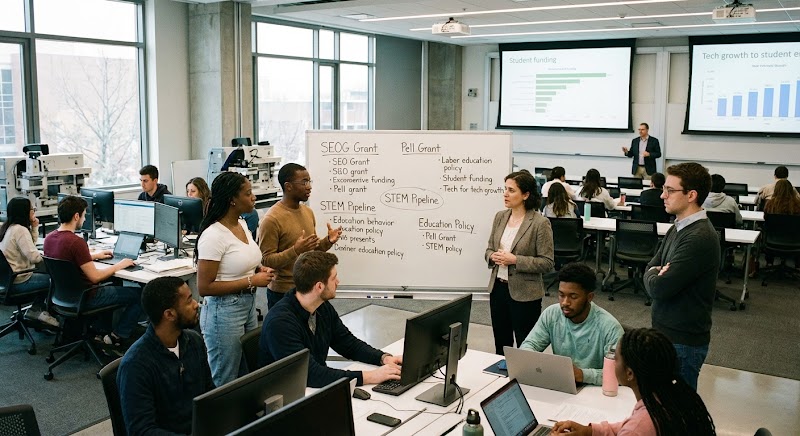
The competition for software engineers, machine learning specialists, and data scientists doesn't start with investment rounds or LinkedIn job postings. It begins quietly, on financial aid forms filled out on university campuses. Federal programs, often seen as government bureaucracy, are actually the initial filters and catalysts of the talent pipeline that defines global technological leadership. The Supplemental Educational Opportunity Grant (SEOG) is one of these critical, yet misunderstood, instruments.
While the market discusses startup valuations and the scarcity of qualified professionals, the SEOG operates at the base of the pyramid, allocating capital to students with exceptional financial needs. This is not philanthropy. It is an instrument of industrial policy. By enabling a talented student without resources to access elite training in computer science or engineering, the government is, in effect, subsidizing the future R&D of its most strategic corporations. Every dollar invested there has the potential to generate an exponential multiple in innovation and intellectual property years later.
Ignoring the mechanism and efficiency of programs like the SEOG is a strategic mistake. Analyzing it purely from a social assistance perspective means losing sight of its role in a nation's competitiveness architecture. The fundamental question is not just 'who receives the money?' but 'what is the ROI of this seed human capital for the innovation ecosystem?'.
The Mechanism Behind Educational Seed Capital
To understand the SEOG's positioning, it's necessary to differentiate it from its better-known relative, the Pell Grant. Both are pillars of the U.S. federal aid system, but they operate with distinct logics. The Pell Grant is an 'entitlement program,' where funding is guaranteed to all who meet the eligibility criteria. The SEOG, on the other hand, is a 'campus-based' program, where universities receive a block of funds and have discretion in their allocation, prioritizing students with the greatest need.
This distinction is crucial. It transforms universities into human capital fund managers. The efficiency with which an institution like MIT or Stanford allocates its SEOG funds can directly impact the quality and diversity of its graduates in STEM fields. The table below details the key operational differences between the two programs:
| Criterion | SEOG (Supplemental Educational Opportunity Grant) | Pell Grant |
|---|---|---|
| Funding Model | Campus-based (funds allocated to universities) | Individual-based (entitlement guaranteed by eligibility) |
| Allocation Process | University distributes funds with discretion | Federal government pays directly based on EFC (Expected Family Contribution) |
| Availability | Limited; funds can run out at each institution | Guaranteed for all eligible applicants |
| Strategic Focus | Serve students with 'exceptional financial need' | Provide a base of aid for low-income students |
| Institutional Flexibility | High. The university can prioritize student profiles | None. The process is standardized and federal |
This structure gives the SEOG a theoretical agility that the Pell Grant lacks. A university could, in theory, use its SEOG funds to proactively support students in emerging, high-demand fields, acting as an active agent in shaping its talent pool.
From Scholarship to Line of Code: The Cascade Effect
The impact of an SEOG Grant doesn't end when tuition is paid. It reverberates throughout the entire tech ecosystem. A student who, thanks to this grant, can focus on their studies without needing a second job is more likely to participate in research projects, hackathons, and startup internships. This early immersion is what differentiates an average graduate from a high-potential talent.
This dynamic directly feeds what tech companies value most: the ability to solve complex problems and practical experience. The SEOG capital, therefore, doesn't just buy education; it buys time and focus, two of the scarcest resources for a low-income student. The absence of this support creates an 'opportunity debt,' where promising talents are forced to optimize for short-term survival at the expense of long-term development. The result is a silent churn of human potential before it even reaches the job market.
The link to the AAU (Association of American Universities) highlighting its funding priorities reinforces this view. When the top U.S. research universities lobby for more funds for science and education, they are not just asking for money for labs. They are asking for the essential raw material to keep the innovation machine running: brilliant minds, regardless of their socioeconomic background.
Latency and Friction: The Model's Vulnerabilities
However, the system is not without critical flaws. The main vulnerability of the SEOG model is its latency and potential misalignment with market needs. The allocation of funds from the federal government to universities is a slow process, based on historical data. Universities, in turn, may have their own bureaucratic biases in the internal distribution of these resources.
This analog structure creates a dangerous mismatch in a world where the demand for technological skills changes in cycles of months, not years. While the market yearns for specialists in 'LLM fine-tuning' or 'prompt' engineers, the funding system may still be optimized for the priorities of a decade ago. There is no real-time feedback mechanism to adjust the allocation of 'human seed capital' to areas of higher strategic demand.
The lack of robust data analysis on the program's outcomes is another systemic failure. What percentage of SEOG recipients graduate in STEM fields? What is their employability rate in high-tech sectors? What is their impact on diversity in major tech companies? Without these metrics, the SEOG risks being a blunt instrument when it could be a surgical tool to solve the most urgent talent bottlenecks.
The search intent for 'seog grant' today leads to generic informational pages. The real opportunity would be to rank with an analysis that questions the program's efficiency and proposes improvements, elevating the domain's authority beyond a simple factual answer and positioning it as a strategic think tank.