Businesses for Sale in San Francisco: Market Analysis 2024
In-depth analysis of the 'business for sale' market in SF. The surplus of listings masks a structural crisis and the decoupling of the asset's real value.
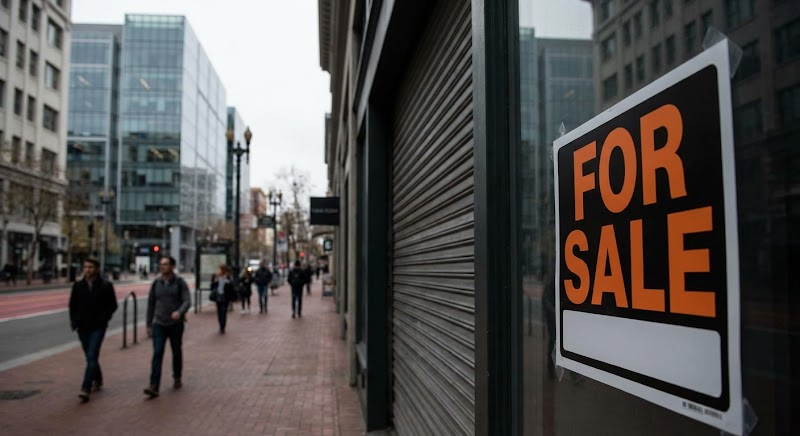
A search for 'business for sale san francisco' on the Google SERP reveals a digital paradox. The results page is a mural of apparent opportunities: charming restaurants in the Mission, established laundromats in Noe Valley, small boutiques with decades of history. However, this abundance of listings is not a sign of a vibrant M&A ecosystem for small and medium-sized businesses. It's the digital echo of a deep economic fracture.
While the ultra-luxury market, symbolized by stratospheric real estate transactions in neighborhoods like Pacific Heights, operates in a parallel reality of global capital, the business fabric that defines San Francisco's urban life is disintegrating. The volume of businesses for sale is an indicator of flight, not opportunity. The strategic question isn't 'which business to buy?' but 'why are so many for sale simultaneously?'. The answer lies in a fundamental imbalance between the cost of operating in the physical space and the value it generates.
The exodus of tech talent, accelerated by remote work policies, has drained the high-income consumer base that sustained many of these businesses. Fixed costs, on the other hand, have remained inflexible. Commercial rents, complex regulations, and one of the highest labor costs in the country form a perfect storm. The 'search intent' behind the main keyword is not, for the most part, from an investor looking for a cash-generating asset, but from an entrepreneur on the edge, seeking an emergency exit.
The Signal Behind the SERP Noise
Analyzing business for sale classifieds is like reading a seismograph of the local economy. The patterns are clear. The overwhelming majority of listings belong to sectors directly impacted by digitalization and the contraction of foot traffic: food service, non-specialized retail, and personal services. These are companies whose value proposition was intrinsically linked to their physical location, an asset that has turned into an anchor.
What is really for sale here? Often, it's not a business with consistent operating profit, but a set of disguised liabilities. The 'asking price' often reflects little more than the value of the (depreciated) equipment and the attempt to transfer a burdensome lease agreement to a new operator. Due diligence reveals a scenario of declining margins and an alarming customer churn rate. The value of the 'brand' or 'goodwill', once a pillar of valuation, has evaporated.
The Bifurcation of Value: Physical Asset vs. Strategic Asset
The crisis exposes an inconvenient truth about business valuation in the digital age. The market has split. On one side, traditional SMBs, heavy in OPEX and dependent on geography. On the other, 'asset-light' businesses, whose value lies in intellectual property, digital customer bases, and scalable technology. The sophisticated buyer isn't looking for a restaurant in San Francisco; they are looking for a food brand with a strong D2C (Direct-to-Consumer) presence that can be operated from anywhere.
| Characteristic | Traditional Asset (SF SMB) | Digital/Strategic Asset |
|---|---|---|
| Geographic Dependency | Total. Value is in the 'location'. | Minimal or none. Remote operation. |
| Fixed Cost (OPEX) | Extremely high (rent, local staff). | Low. Cloud infrastructure, distributed team. |
| Scalability | Limited by physical capacity. | Virtually unlimited, global. |
| Asset Base | Physical equipment, lease agreement. | Source code, IP, customer data, brand. |
| Valuation Multiple | Low (1-3x EBITDA, if any). | High (5-10x+ ARR or other revenue multiples). |
| Buyer Profile | Individual operator, family successor. | PE fund, strategic company, 'acqui-hire'. |
Geographic Decoupling and AI Infrastructure
The phenomenon goes beyond remote work. The rise of generative AI models is accelerating the decoupling of value and location. Services that once required face-to-face interaction or a local team—such as consulting, graphic design, or even basic legal support—are being automated or outsourced to global platforms at zero marginal cost. A local business offering these services now competes not with the business across the street, but with a fine-tuned LLM or a SaaS platform.
This tectonic shift redefines what a 'strategic asset' is. The value is no longer in the ability to perform a service in a premium location, but in owning proprietary data to train an AI model, or in engineering a workflow that efficiently integrates automation. The business for sale in San Francisco, with its pre-AI cost structure, becomes an artifact of a past economic era.
The Hidden Risks in the Transaction
For the potential buyer attracted by a seemingly low price, the risks are immense and often underestimated. The main one is the lease agreement. Many landlords, facing record vacancy rates, are inflexible, trapping businesses in long-term agreements signed at the market's peak. Taking over a business means inheriting this obligation, which can quickly outweigh any profit potential.
Another blind spot is the erosion of local domain authority. A restaurant that thrived on Yelp reviews and local organic traffic may find its SERP visibility has been cannibalized by delivery giants like DoorDash and Uber Eats, who now control the top of the search funnel for 'food near me'. The business no longer owns its customer acquisition channel; it merely rents a space on a third-party platform. This represents a fatal strategic vulnerability that rarely appears on the balance sheet.
The future of business acquisition in urban centers like San Francisco will undergo a radical redefinition. The model of 'buying a business' will be replaced by 'acquiring value components'. Investors and strategic companies will no longer seek a registered business with four walls and a team. They will dissect the opportunity: acquiring the customer list of a failed company for qualified cold outreach, buying the patent of a struggling hardware startup, or 'acqui-hiring' the engineering team of a company that failed to find product-market fit.
What is for sale on the streets of San Francisco are not businesses in the classic sense, but rather a set of fragmented assets, whose real value can only be unlocked if they are removed from their physical shell and unsustainable cost structure. The real opportunity lies not in perpetuating the old model, but in arbitrating this transition, identifying and extracting the digital value trapped in analog carcasses.